
How HR Tech Companies Build Thought Leadership
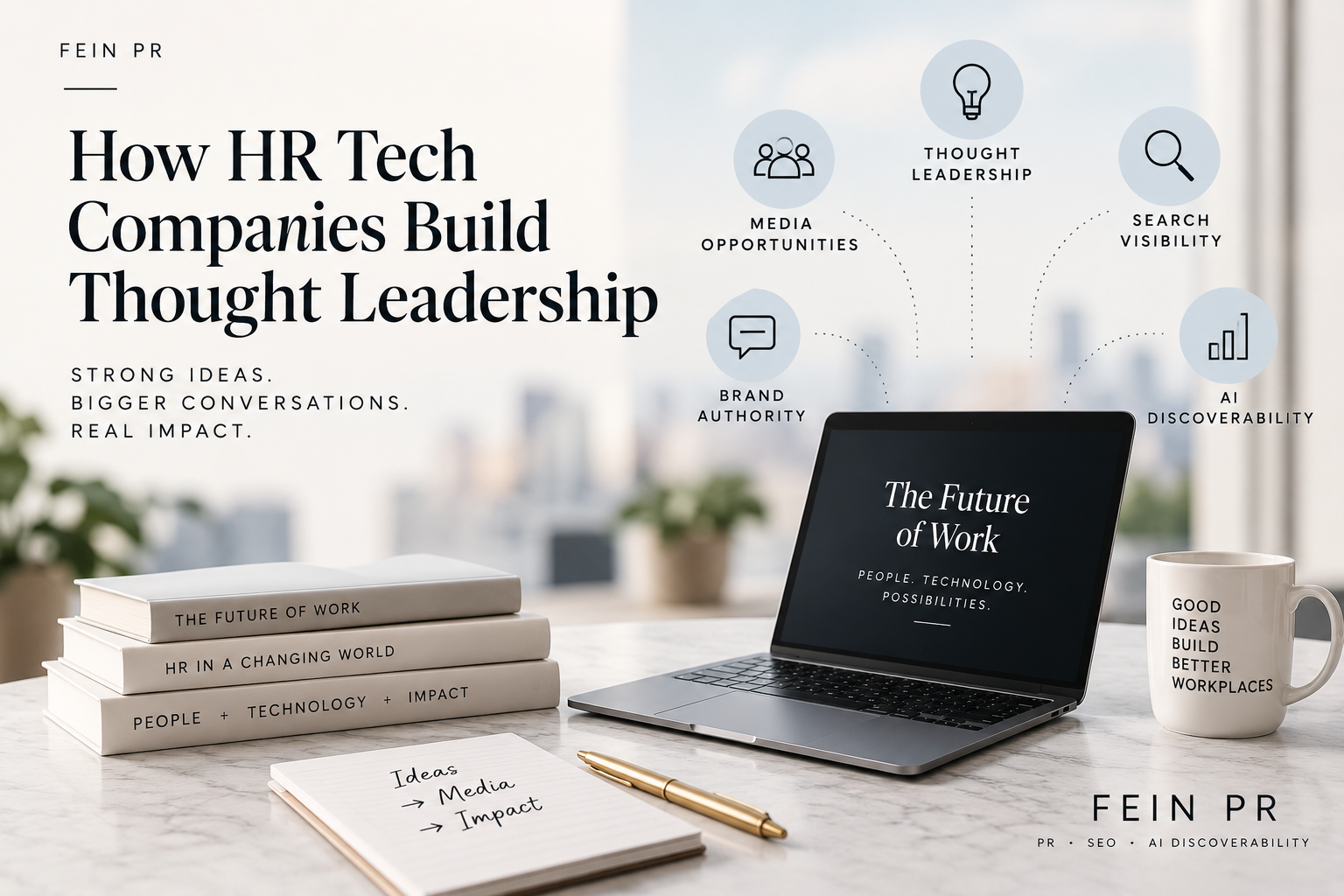
A modern editorial-style illustration representing HR tech thought leadership, featuring a professional workspace with a laptop displaying “The Future of Work,” books about HR and technology, and visual icons representing thought leadership, media opportunities, brand authority, search visibility, and AI discoverability. The design conveys expertise, credibility, innovation, and the connection between strong ideas and business impact.
HR technology has become an increasingly crowded space.
From employee benefits platforms and payroll software to workforce management, recruiting technology, AI-powered HR tools, and employee experience platforms, companies are competing for the attention of HR leaders, business owners, investors, and the media.
Having a strong product is important. But in a crowded category, being known for something can be just as valuable as what your product does.
That is where thought leadership comes in.
For HR tech companies, thought leadership is about putting forward a clear point of view on the issues shaping the future of work—not simply talking about the company's product.
When done well, it can help a company build credibility, create media opportunities, strengthen its brand, and become associated with the conversations its customers already care about.
What Is Thought Leadership for HR Tech Companies?
Thought leadership is the process of consistently sharing expert perspectives, insights, and opinions on topics that matter to a particular industry or audience.
For an HR tech company, that could mean having a perspective on:
The future of work
Artificial intelligence in HR
Employee benefits
Recruiting and retention
Workplace culture
Employee engagement
Remote and hybrid work
Workforce management
HR automation
The changing expectations of employees
The role of technology in the workplace
The important distinction is that thought leadership isn't simply content marketing.
A product blog might explain how a company's software works.
Thought leadership explains what the company believes is changing—and why it matters.
Why HR Tech Companies Need Thought Leadership
HR leaders have no shortage of technology companies competing for their attention.
If every company is saying that its platform is innovative, efficient, easy to use, or powered by AI, those claims start to blend together.
A strong point of view gives a company something more distinctive.
Thought leadership can help HR tech companies:
Build credibility with potential customers
Differentiate themselves from competitors
Generate media opportunities
Position executives as industry experts
Create conversations around emerging trends
Support sales and business development
Build brand authority
Strengthen search visibility
Increase AI discoverability
Instead of simply asking potential customers to believe that a company is an expert, thought leadership gives them evidence of what the company actually knows.
Start With What You Know Best
The strongest thought leadership usually comes from expertise that already exists inside the company.
HR tech executives are often seeing changes before they become mainstream because they're working directly with employers, employees, HR teams, and business leaders.
That creates valuable insight.
For example, an HR technology company might notice that:
Employers are changing how they approach benefits
Companies are using AI differently than they expected
Certain employee expectations are becoming more common
HR teams are struggling with a specific challenge
A particular workplace trend is being misunderstood
Those observations can become the foundation for thought leadership.
The goal isn't to comment on every HR trend.
It's to become known for a few areas where your company has something genuinely interesting to say.
Turn Company Data Into Industry Insights
HR tech companies often have access to something incredibly valuable: data.
Depending on the company and the information it can responsibly share, proprietary data can provide a powerful foundation for thought leadership.
Instead of simply saying:
"Employee engagement is changing."
A company might publish research showing how employee engagement has changed among its customers or across a particular segment.
Data can become:
Original research
Industry reports
Media pitches
Executive commentary
LinkedIn content
Conference presentations
Thought-leadership articles
This gives journalists and industry audiences something they can't get from a generic opinion piece.
Put the Founder or Executive Front and Center
A company's expertise doesn't have to live entirely on its website.
The people behind the company can become important voices in the industry.
Founders and executives can share their perspectives through LinkedIn content, media interviews, podcasts, contributed articles, speaking opportunities, and expert commentary.
For example, instead of only promoting an HR platform's latest feature, an executive might discuss:
"What HR leaders are getting wrong about AI adoption."
Or:
"Why employee benefits are becoming a recruiting strategy."
Or:
"The workplace skills companies will actually need over the next five years."
Those topics give the executive a reason to participate in a larger conversation.
And over time, that visibility can transfer back to the company.
Don't Make Every Thought Leadership Piece a Sales Pitch
This is one of the biggest mistakes companies make.
If every article, LinkedIn post, or media pitch eventually becomes:
"And that's why you should use our platform..."
it's no longer thought leadership. It's advertising.
Thought leadership should provide something useful even if the reader never becomes a customer.
That could be a new perspective, useful data, an explanation of a complicated issue, or an informed opinion about where the industry is headed.
Teach first. Sell less.
The credibility you build can ultimately make the selling much easier.
Use PR to Turn Expertise Into Earned Media
Thought leadership and PR can work particularly well together.
An executive who consistently shares thoughtful perspectives becomes more useful to journalists.
Instead of pitching an executive as:
"CEO of an HR technology company available for interviews."
You can pitch them as:
"An HR technology executive seeing a major shift in how companies are approaching employee benefits."
The second is a story.
That's an important distinction.
The goal is to make the expert relevant to the journalist's story—not simply promote the expert's company.
Over time, this can lead to expert commentary, media interviews, founder profiles, podcasts, contributed content, and other earned media opportunities.
Build Thought Leadership Around Trends
HR is constantly changing, which creates an ongoing supply of potential conversations.
But companies don't need to chase every trend.
Look for the intersection between what is happening in the market and what your company actually knows.
For example:
Trend: AI is changing recruiting.
Thought leadership angle: What recruiters are getting wrong about using AI to evaluate candidates.
Or:
Trend: Companies are cutting or changing employee benefits.
Thought leadership angle: Why employers should think about benefits as a retention strategy—not simply an expense.
The trend gets attention.
Your perspective gives people a reason to listen.
Make Thought Leadership Consistent
One great article isn't going to establish someone as an industry authority.
Authority builds through repetition.
The more consistently an executive contributes meaningful insights around a particular subject, the more likely people are to associate that person with it.
That consistency can happen across multiple channels:
LinkedIn
Earned media
Podcasts
Industry publications
Speaking opportunities
Company blog content
Original research
Newsletters
These channels don't have to operate independently.
One strong idea can become a LinkedIn post, a media pitch, a podcast topic, and a contributed article.
You don't necessarily need more ideas. You need to get more mileage out of the good ones.
Thought Leadership Can Support SEO and AI Discoverability
Thought leadership also has value beyond immediate visibility.
Every time an HR tech company publishes useful, relevant content or earns credible media coverage, it creates more information about the company and its expertise across the web.
That can support a stronger search presence.
For example, if an executive consistently publishes and earns coverage around employee benefits, HR automation, and the future of work, those topics become increasingly associated with the company and its leadership.
That matters as search evolves.
People are increasingly asking search engines and AI tools questions like:
Who are the experts in HR technology?
What companies are leading employee benefits innovation?
What is changing in workplace technology?
Which HR platforms should businesses consider?
A strong digital footprint gives search engines and AI systems more context about who you are, what you know, and what your company is known for.
That's one reason modern PR increasingly overlaps with SEO and AI discoverability.
Measure Authority, Not Just Traffic
Thought leadership can be difficult to measure if the only metric you're looking at is website traffic.
Look at the bigger picture.
Are journalists reaching out to your executives?
Are your spokespeople being quoted repeatedly?
Are invitations to podcasts or speaking opportunities increasing?
Are people beginning to associate your company with a particular topic?
Are high-quality publications mentioning your executives?
Are your media placements creating backlinks and referral traffic?
Are prospects finding your company through searches related to your area of expertise?
These are all signals that authority is building.
The Bottom Line
HR tech companies don't just need to tell people that they are innovative.
They need to have something interesting to say about where HR and the workplace are going.
The companies that consistently share useful insights, put their experts into relevant conversations, contribute to the media, and build authority around specific areas of expertise have an opportunity to stand out in an increasingly crowded market.
Thought leadership isn't about trying to become famous.
It's about becoming known for something.
And for an HR tech company, that can become one of its most valuable PR assets.