
How to Get PR Pitches Opened in 2026 (Before Journalists Delete Them)
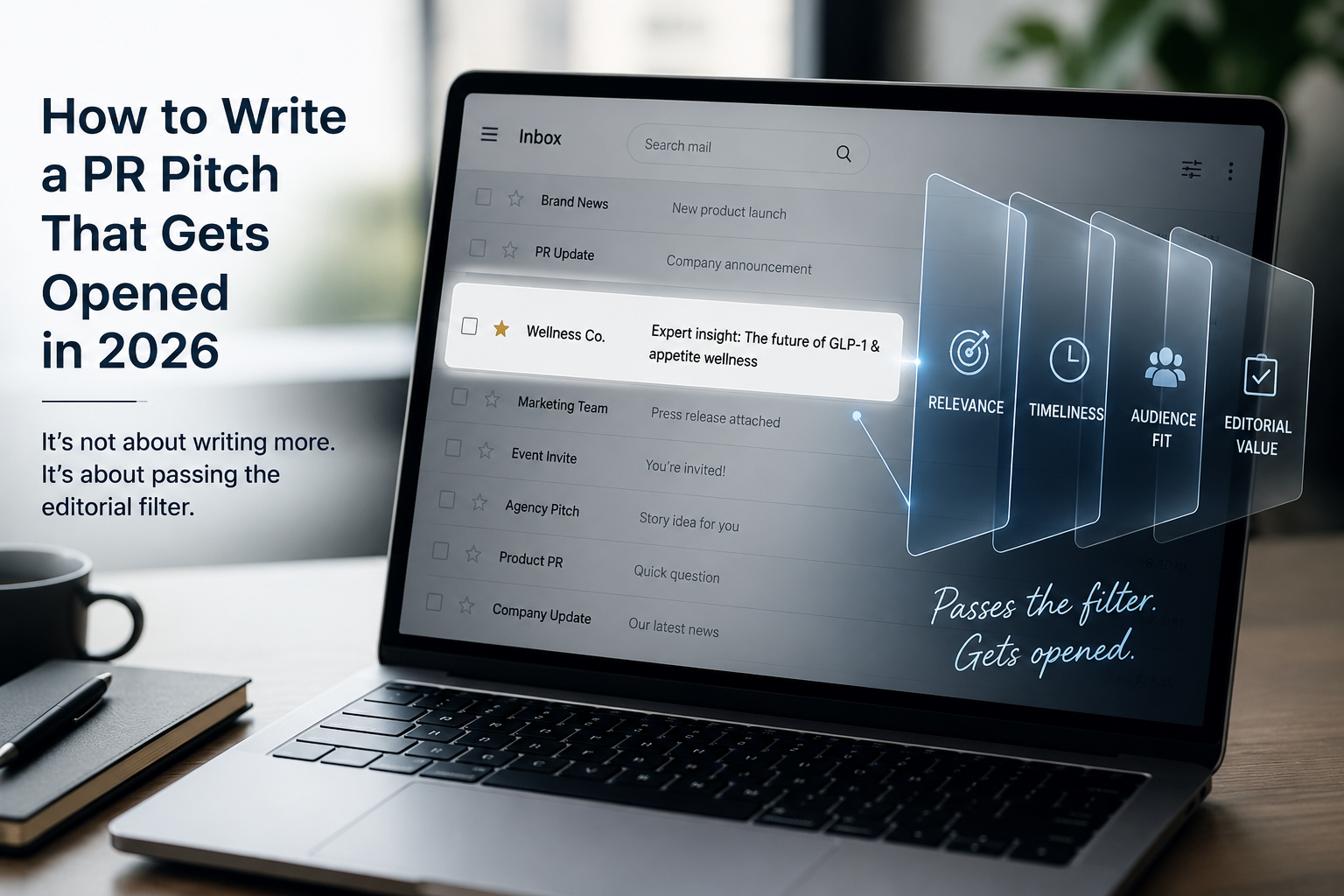
Inbox view showing PR pitch workflow with editorial filtering process for 2026 media outreach strategy.
Most PR pitches don’t fail in the inbox—they fail before the inbox ever matters.
By 2026, journalists aren’t just deciding whether to open your email. They’re making split-second editorial judgments based on relevance signals, narrative fit, and whether your pitch belongs in the ecosystem of stories they already cover.
If your pitch doesn’t pass that filter, it doesn’t matter how well written it is. It won’t get opened.
This is where most PR strategy breaks down: it focuses on writing better emails instead of building stronger positioning systems that earn attention in the first place.
That distinction is exactly what sits at the center of a modern Boutique PR approach—where pitching is the outcome of positioning, not the starting point.
1. Subject lines are no longer hooks—they’re classification signals
Subject lines used to be about curiosity.
Now they function more like editorial tagging systems.
A journalist is subconsciously scanning:
What category is this?
Does this match my beat?
Is this timely enough to matter today?
Does this align with what my audience is already reading?
If your subject line doesn’t immediately signal relevance, it doesn’t get opened.
Weak:
“Exciting new skincare brand launch”
Strong:
“Dermatologist-backed skincare trend tied to rising barrier repair demand”
One sounds promotional. The other sounds like coverage.
This is also where many brands miss the point—they’re optimizing for attention instead of editorial placement. That shift is central to how we approach Services, where messaging is built for media fit before outreach ever begins.
2. The first two lines determine whether you pass the editorial filter
In 2026, most journalists decide whether to continue reading within seconds.
Your opening lines must immediately establish:
Why this matters now
Why this is a story (not an update)
Why it fits this journalist specifically
If those aren’t instantly clear, the pitch is archived.
Weak:
“I’d love to introduce you to our founder-led wellness brand…”
Strong:
“As GLP-1 usage increases, appetite-related wellness products are becoming a new editorial category in health coverage…”
One starts with the sender. The other starts with the market shift.
This framing logic is foundational to Thought Leadership, where the goal is not to promote a founder, but to position them as a source of insight inside a larger narrative journalists are already tracking.
3. Journalists don’t open pitches—they open relevance loops
A common misconception in PR is that your pitch competes with other pitches.
It doesn’t.
It competes with:
breaking news cycles
pre-planned editorial calendars
trending cultural narratives
SEO-driven assignments
AI-assisted topic planning
So your pitch only gets opened if it extends an existing narrative, not if it introduces something new in isolation.
That means effective pitching in 2026 is about identifying and attaching to relevance loops like:
emerging industry shifts
recurring news patterns
search demand trends
cultural behavior changes
This is where Backlinks & SEO-Driven PR becomes strategically important—not as a technical SEO tactic, but as a way to understand what narratives already have demand behind them.
If something is not being searched, discussed, or reported on in some form, it is significantly harder to get editorial attention for it.
4. The pitch must feel ready to publish
One of the fastest ways to lose a journalist’s attention is to make them do the work of shaping your story.
If a pitch requires interpretation, restructuring, or guessing the angle, it gets deprioritized.
A strong pitch in 2026 includes:
a clear headline-style angle
a defined narrative hook
1–2 usable quotes
supporting proof points (data, timing, relevance)
You are not asking:
“Is this interesting?”
You are signaling:
“This is already editorially usable.”
This is a core principle inside Services, where pitching is treated less like outreach and more like packaging a ready-to-run story for media workflows.
5. Timing matters less than narrative alignment
Traditional PR advice focuses heavily on timing.
In practice, timing only matters after alignment exists.
A perfectly timed but misaligned pitch still gets ignored.
A well-aligned pitch can sit for days and still get picked up.
Alignment is determined by:
beat relevance
audience match
narrative fit
platform suitability (newsletter, digital, broadcast, syndication)
This is why a Monthly PR Plan is often more effective than one-off pitching bursts—it builds narrative consistency over time instead of relying on timing luck.
6. The real goal isn’t the open—it’s recognition over time
Even if a pitch isn’t opened immediately, it can still contribute to long-term visibility.
Journalists often return to:
recognizable sender names
saved emails
repeated narrative exposure
searchable inbox history
This is where PR becomes cumulative rather than transactional.
The brands that consistently get coverage aren’t sending dramatically better emails—they’re building repeated narrative presence across multiple touchpoints until recognition lowers friction.
That compounding visibility is also reflected in Press Highlights, which function less as proof of past coverage and more as reinforcement of ongoing editorial credibility.
Final takeaway
A PR pitch in 2026 is not an email.
It’s a relevance test inside an editorial system.
If it doesn’t immediately signal fit, usefulness, and narrative alignment, it never enters consideration.
So the question is no longer:
“How do I write a better pitch?”
It becomes:
“How do I build the kind of positioning that makes my pitch impossible to ignore?”
That’s the foundation of modern PR—and the system everything else sits on.