
What to Do After You Get Press Coverage: 8 Ways to Make Every Placement Work Harder
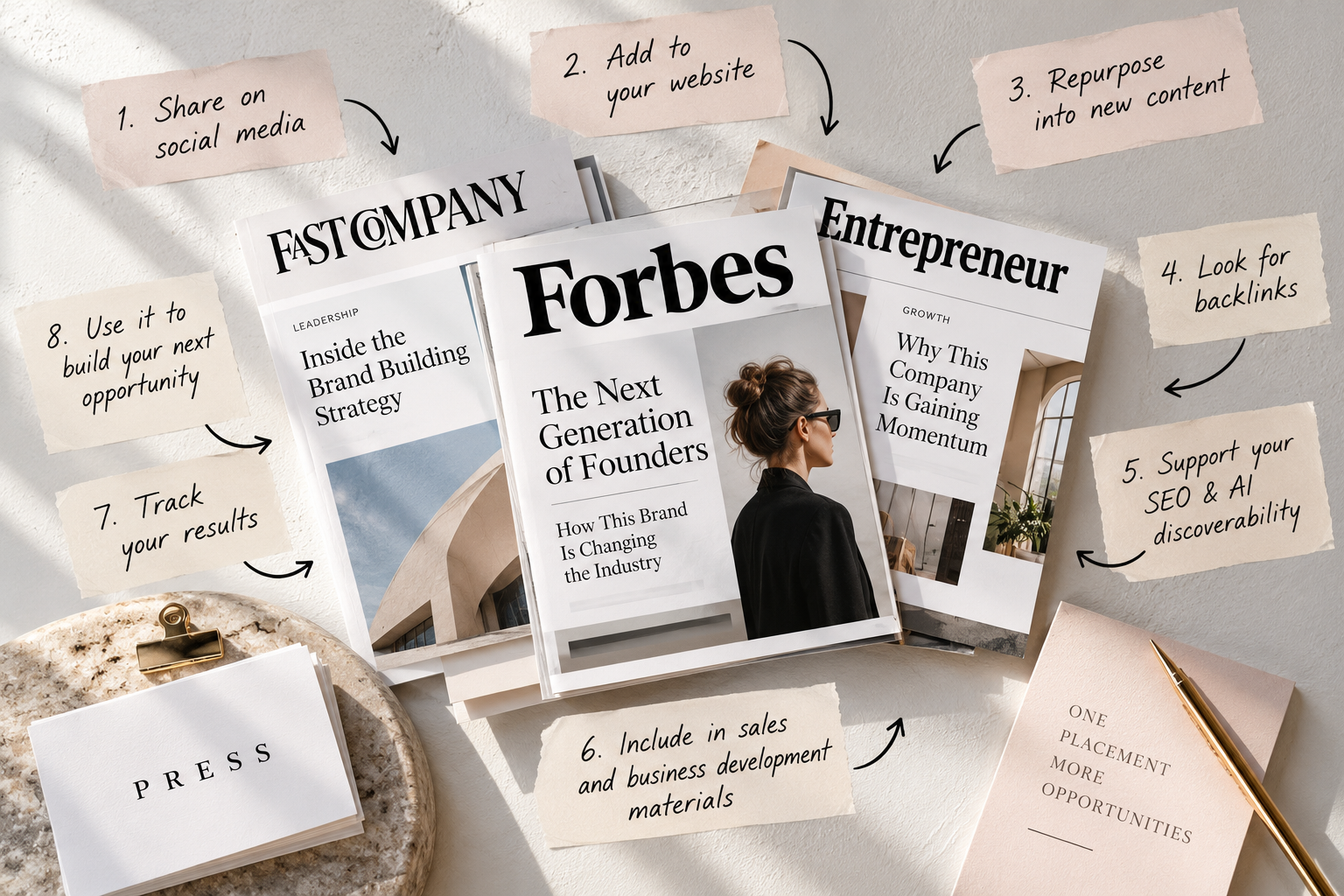
Editorial flat-lay collage of magazine clippings and handwritten notes illustrating eight ways to maximize press coverage, including sharing on social media, repurposing content, building backlinks, improving SEO and AI discoverability, tracking results, and generating future PR opportunities.
Getting featured in a publication is exciting. After all the pitching, follow-ups, and coordination, seeing your brand or a client's name in an article is a win.
But here's something businesses don't always think about: getting press coverage is only part of the opportunity. What you do with that coverage afterward matters, too.
A media placement can help build credibility, introduce your brand to new audiences, strengthen your online presence, and give potential customers another reason to trust you. But those benefits don't automatically happen just because an article goes live.
You need to make the most of it.
Whether you've landed a feature in a major national publication, been quoted as an industry expert, or secured coverage in a niche outlet that reaches your ideal audience, here's how to get more value from your PR placements.
1. Share the Coverage on Your Social Channels
Start by sharing the article on your company's social media channels. LinkedIn is especially useful for B2B companies, founders, executives, and professional service providers, while Instagram can work well for consumer, lifestyle, beauty, and wellness brands.
Don't just post the link with a generic caption like "We're excited to be featured!"
Give people a reason to care about the story.
For example, you could highlight the insight you shared, explain why the topic matters to your industry, or offer a takeaway from the article. If a founder was quoted, consider having them share it from their personal LinkedIn account, too.
The goal is to make the coverage part of a larger conversation rather than simply announcing that it exists.
Pro tip: Don't feel like you can only share an article once. You can repurpose the same placement into different posts by highlighting a quote, discussing a key takeaway, or connecting the story to a current industry conversation.
2. Add the Placement to Your Website
Your website is often one of the first places people go when they're evaluating your business. Press coverage can help reinforce your credibility when potential customers, partners, investors, or journalists are researching your brand.
There are a few ways to incorporate earned media into your website:
Create a press or media page. Organize notable features, interviews, and expert quotes in one place.
Add a media mention to a relevant case study. If the coverage relates to a particular service, product, or area of expertise, connect the placement to that work.
Update your homepage or About page. If you've earned a particularly relevant feature, consider highlighting it where it supports your positioning.
Include a press logo section when appropriate. Displaying publication logos can help communicate credibility, provided you have permission to use them and follow the publication's brand guidelines.
You don't need to feature every single mention on your homepage. Prioritize the placements that best support your brand positioning and the audiences you want to reach.
3. Repurpose the Coverage Into New Content
One of the most overlooked benefits of PR is that a single placement can become the starting point for several additional pieces of content.
Think about what the article gives you: an expert perspective, a useful quote, a timely topic, or a story that connects to your business.
You can build on that material in several ways:
Turn a quote from the article into a LinkedIn post.
Create an Instagram carousel explaining the main takeaway.
Expand on the topic in a blog post.
Use the article as a starting point for an email newsletter.
Record a short video discussing the question or issue covered.
Share a founder's perspective on why the topic matters now.
For example, if a founder is quoted in an article about the future of AI, they could write a LinkedIn post explaining what they think the article gets right, what they're seeing in their own industry, or what businesses should be paying attention to next.
The key is to add something new rather than simply reposting the same link everywhere.
A good PR placement doesn't have to be a one-day moment. It can give you ideas for future content that reinforces the expertise you want your brand to be known for.
4. Look for Opportunities to Earn a Backlink
Not every press placement includes a link to your website, but it's worth checking.
A backlink is a hyperlink from another website to yours. Relevant backlinks can help people discover your business and may contribute to your website's search engine visibility. The value depends on factors such as relevance, editorial context, and the overall quality of the linking page.
When an article mentions your company but doesn't link to your website, consider whether a link would genuinely help the reader.
If it would, you can send the journalist or editor a brief, polite note asking whether they would consider adding one. Keep the request low-pressure, and don't assume a link can or will be added.
For example:
"Thanks again for including [Company] in the piece. I noticed the article mentions our company but doesn't link to our website. If it's helpful for readers, would you consider adding a link to [URL]? Appreciate the coverage either way!"
You should also check that existing links work correctly and point to the most relevant page on your website.
Remember: A link isn't guaranteed, and a placement can still be valuable without one. Editorial credibility, relevant referral traffic, and the association with your area of expertise can all matter.
For more on this topic, explore our Backlinks & SEO-Driven PR services.
5. Connect the Placement to Your SEO and AI Discoverability Strategy
Press coverage can contribute to a stronger online presence, but its value isn't limited to the article's immediate audience.
When your company and its experts appear in credible publications, those mentions become part of the broader information available online about your brand. Depending on the publication, article content, links, and how your brand is described, that coverage may support your efforts to establish expertise and improve discoverability.
This is particularly relevant as people increasingly use a combination of traditional search engines and AI-powered tools to research companies, compare services, and find expert perspectives.
There is no guarantee that one article will improve your search rankings or lead to your brand being mentioned in an AI-generated answer. But consistently building relevant, credible visibility can be a useful part of a broader SEO and AI discoverability strategy.
After a placement goes live, ask yourself:
Does the article reinforce what we want our brand to be known for?
Is our company described accurately and consistently?
Does the placement link to a relevant page on our website?
Does it provide an opportunity to create related, useful content?
Are we building a body of credible information about our expertise over time?
The bigger picture matters. One placement is a single data point; a consistent strategy helps connect your expertise with the conversations and topics you want to own.
6. Add the Placement to Your Sales and Business Development Materials
Press coverage isn't only useful for marketing. It can also support sales conversations, partnership discussions, investor communications, and business development.
If a prospective customer is deciding whether to work with you, relevant third-party coverage can provide another signal of credibility.
Consider adding notable placements to:
Sales presentations and pitch decks
Business proposals
Founder or executive biographies
Investor presentations, where relevant
Partnership outreach
Email signatures or follow-up emails, when appropriate
The important word here is relevant. A feature that directly reinforces your expertise or speaks to your target audience will usually be more useful than a collection of unrelated publication logos.
For example, a healthcare company might highlight coverage discussing its clinical expertise, while a technology founder might use an interview about their industry perspective to support a speaking or partnership opportunity.
Use the coverage to substantiate a point, not simply to decorate a presentation.
7. Track What Happens After the Article Goes Live
It's easy to track the number of placements secured each month. It's more difficult, but often more useful, to understand what those placements contribute to your larger business goals.
After an article is published, monitor the metrics that make sense for the campaign.
Depending on your objectives, those might include:
Referral traffic: Are people clicking through from the article to your website?
Backlinks and referring domains: Did the placement generate a link, and is your site attracting links from relevant external websites?
Branded search activity: Are more people searching for your company or its experts? Remember that changes can have multiple causes.
Website engagement: What do visitors from the placement do once they arrive?
Qualified inquiries: Did the coverage contribute to relevant leads, conversations, or partnership opportunities?
Message pull-through: Does the article reinforce the key messages and expertise you want associated with your brand?
Ongoing visibility: Is your brand continuing to appear in relevant conversations and publications over time?
You won't be able to attribute every business outcome directly to a single article. PR often contributes to awareness and credibility over a longer period, alongside other marketing and sales activities.
That's why it's helpful to establish campaign goals before outreach begins. If the objective is to drive website traffic, you'll evaluate different metrics than you would for a campaign focused on executive positioning or industry credibility.
The goal isn't to measure everything. It's to measure what matters to the business.
8. Use the Placement to Build Your Next PR Opportunity
A successful placement can open the door to future opportunities.
Once an article is published, look at the bigger picture. What topic did the journalist cover? What questions remain unanswered? Is there a related trend emerging? Could the expert offer a fresh perspective on another timely issue?
For example, a founder quoted in a story about small-business growth might later have insights on hiring, financing, customer acquisition, or the changing needs of entrepreneurs.
That doesn't mean sending the same pitch to the same journalist immediately after publication. Instead, use the coverage to understand which topics resonate and where your expertise could contribute something new.
You can also use the placement as context when introducing yourself to other journalists, provided you keep the outreach relevant to their beats and current reporting needs.
Over time, each story can help clarify your strongest angles, establish your credibility as a source, and inform your next round of outreach.
PR works best when media relations is treated as an ongoing relationship-building process, not a series of disconnected wins.
A Simple Post-Coverage Checklist
Before moving on to the next pitch, run through this quick checklist.
Share the article on relevant social channels.
Add the placement to your website or press page, if appropriate.
Repurpose a quote or insight into original content.
Check for a backlink and confirm any existing links work.
Incorporate the placement into relevant sales or business development materials.
Record the coverage and any relevant campaign metrics.
Identify potential follow-up angles for future outreach.
You don't need to do all seven things for every placement. A major national feature may warrant a broader rollout, while a short expert quote might only need to be logged, shared, and added to your media tracking.
The point is to have a process so that good coverage doesn't disappear into a spreadsheet and get forgotten.
The Bigger Picture: PR Doesn't End When the Article Is Published
Securing press coverage is an important part of a PR strategy, but it's not the whole strategy.
The real opportunity is to use each placement to reinforce your positioning, share your expertise, build credibility, and create additional ways for people to discover your business.
That takes more than counting articles. It means thinking about how earned media connects with your website, content, SEO, thought leadership, and broader business goals.
At Fein PR, we approach PR as an ongoing effort to build visibility and authority — not simply to collect press clips. From strategic media relations and thought leadership to SEO-driven PR and AI discoverability, the goal is to help brands build a credible, consistent presence over time.
Have you recently secured press coverage and aren't sure how to make the most of it? Get in touch with Fein PR to discuss how earned media can support your broader brand and visibility strategy.
Frequently Asked Questions
Should I share every press mention on social media?
Not necessarily. Prioritize coverage that is relevant to your audience, reinforces your expertise, or offers a useful conversation starter. You can share smaller mentions selectively rather than giving every placement the same level of promotion.
Should I add every press placement to my website?
Keep your press page curated and up to date. Highlight the most relevant coverage, and consider placing specific features alongside the services, experts, or case studies they support.
What if my press coverage doesn't include a backlink?
A placement can still provide value through visibility, credibility, and association with a relevant topic. If a link would genuinely help readers, you can politely ask the publication to consider adding one, but the decision is theirs.
Does press coverage help with SEO?
It can support a broader SEO strategy, particularly when relevant coverage earns editorial backlinks or sends interested visitors to your site. However, a media mention does not guarantee improved rankings, and not every placement will have the same impact.
Can press coverage help with AI discoverability?
Credible media mentions can contribute to the broader online information available about a brand and its expertise. However, no individual placement guarantees that an AI tool will cite or recommend your business. A consistent, accurate, and relevant online presence is a more useful long-term objective.
How do I measure the ROI of press coverage?
Start with the objective of the PR campaign. Depending on the goal, track metrics such as referral traffic, backlinks, branded search activity, qualified inquiries, message pull-through, or progress toward establishing a particular area of expertise. Consider the wider context rather than attributing every change to a single placement.