
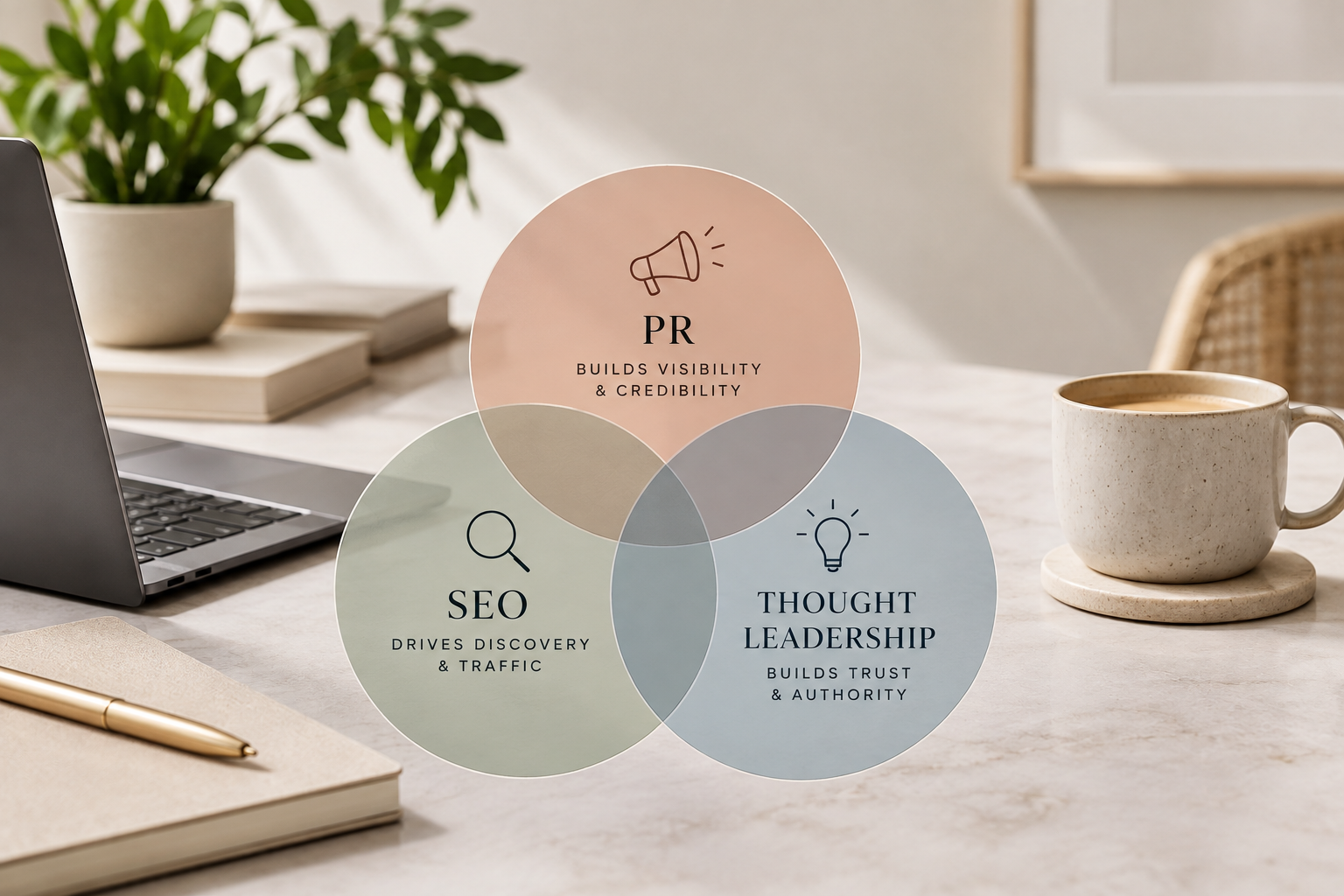
Venn diagram illustrating how PR, SEO, and thought leadership work together to build brand authority, combining visibility and credibility, search discovery and traffic, and trust and expertise.
PR, SEO, and thought leadership are often treated as separate marketing strategies. PR focuses on media coverage. SEO focuses on search rankings. Thought leadership focuses on sharing expertise.
But the real value comes from bringing them together.
When these strategies work in tandem, they can help a brand build credibility, strengthen its online presence, and become easier to discover across traditional search engines and AI-powered tools like ChatGPT.
For businesses looking to build long-term visibility, the connection between PR, SEO, and thought leadership is becoming increasingly important.
What Is the Difference Between PR, SEO and Thought Leadership?
Each strategy serves a different purpose, but they share a common goal: helping the right audience discover, recognize, and trust your brand.
Public relations builds credibility.
PR puts your brand in front of relevant audiences through earned media coverage, expert commentary, interviews, and other third-party mentions. When a journalist quotes your founder or features your company in a reputable publication, it gives your brand visibility beyond its own channels.
SEO improves discoverability.
Search engine optimization helps people find your website when they're looking for information, products, services, or expertise related to your business. This includes creating useful content, earning relevant backlinks, optimizing website pages, and building a clear structure that helps search engines understand what your brand does.
Thought leadership establishes expertise.
Thought leadership gives your brand a point of view. Through expert commentary, contributed articles, interviews, LinkedIn content, and original insights, founders and executives can demonstrate what they know and why their perspective matters.
On their own, each strategy has value. Together, they can create a stronger foundation for brand authority.
1. PR Creates Third-Party Credibility
Your website can tell people that your company is an industry leader. Earned media can help reinforce that message.
When a founder is quoted in a relevant publication, a company is featured in an industry article, or an executive contributes expert commentary, that coverage introduces the brand to new audiences and provides an independent source of information about its expertise.
These placements can also create opportunities for SEO through relevant backlinks and brand mentions across the web.
A link from a reputable publication can help search engines discover your website and provide context about your brand. Even when an article doesn't include a backlink, the mention can still introduce your business to potential customers and contribute to your broader online presence.
The goal isn't simply to accumulate press logos. It's to earn coverage that reinforces what your company wants to be known for.
2. SEO Helps Extend the Value of PR
Media coverage shouldn't be the end of the story.
A well-placed article can generate attention when it first publishes, but there are also opportunities to extend its value over time.
For example, an interview with your founder might include a link to your website. That article could continue to be discovered through search, sending referral traffic and introducing new audiences to your business.
You can also build on the coverage yourself. Add it to your website's press page, share it on LinkedIn, incorporate relevant insights into your blog, or use the article to support future sales and marketing conversations.
PR can also inform your SEO strategy. If your brand consistently earns coverage around a particular topic, that may be an opportunity to strengthen your website content around the same subject.
Think of a company that wants to be recognized for AI-powered business solutions. If its executives are regularly featured discussing AI trends, its website should support that positioning with useful, detailed content about its expertise.
The result is a more consistent online presence, with earned media and owned content reinforcing the same areas of authority.
3. Thought Leadership Gives PR a Stronger Story to Tell
Journalists aren't just looking for companies that want publicity. They're looking for useful insights, informed perspectives, and people who can explain why a topic matters.
That's where thought leadership comes in.
A founder with a clear perspective on an industry trend has more to offer a reporter than a company relying solely on product announcements. Original observations, customer insights, industry experience, and informed opinions can all become the foundation for stronger media pitches.
Thought leadership also gives PR a more consistent source of story ideas.
Instead of waiting for a funding announcement, product launch, or company milestone, brands can contribute to ongoing conversations in their industries.
For example, a healthcare executive might offer insight into changing patient expectations. A technology founder could explain how businesses are adopting AI. A consumer brand leader might weigh in on shifts in purchasing behavior.
These perspectives can support media outreach, contributed articles, podcast interviews, and other opportunities to demonstrate expertise.
The key is consistency. When your brand repeatedly contributes meaningful insights to a specific conversation, you give audiences and media professionals more reasons to associate your name with that subject.
4. Together, These Strategies Support AI Discoverability
Search is evolving. People still use traditional search engines to find information, but they're also asking AI-powered tools questions and looking for recommendations, explanations, and comparisons.
This creates another reason to connect PR, SEO, and thought leadership.
AI-powered search tools draw on information from various sources, depending on the platform and query. A brand's website is one part of its online footprint. Relevant media coverage, expert commentary, industry publications, and other credible sources can also help establish context about a company and its expertise.
This doesn't mean that earning press coverage guarantees your brand will appear in an AI-generated answer. There is no single PR tactic that can guarantee that outcome.
Instead, the opportunity is to build a more complete and consistent body of information about your brand.
Your website explains what you do. Your thought leadership demonstrates what you know. Earned media provides independent coverage of your expertise.
When these sources consistently support the same positioning, they can contribute to a stronger foundation for discoverability across search environments.
For brands investing in AI discoverability, PR is worth considering as part of the broader strategy rather than treating it as a standalone awareness tactic.
5. What This Looks Like in Practice
Imagine a B2B technology company that wants to become known for its expertise in artificial intelligence.
A connected PR, SEO, and thought leadership strategy might look like this:
Thought leadership: The founder shares informed perspectives on AI adoption, publishes LinkedIn posts, and contributes insights about challenges facing businesses.
PR: The PR team pitches the founder for relevant interviews, expert commentary, podcasts, and contributed articles.
SEO: The company develops useful website content around its core areas of expertise and earns relevant backlinks through media coverage.
Content amplification: The company shares published coverage, links to it from its website, and repurposes insights into additional content.
Measurement: The team tracks media placements, relevant backlinks, referral traffic, branded search activity, and changes in website visibility over time.
Each activity supports the others.
Thought leadership creates ideas for PR. PR introduces those ideas to new audiences and can generate backlinks. SEO helps the company's website communicate its expertise. Content amplification extends the life of earned coverage.
Over time, the company builds a more consistent presence around the topics it wants to own.
Results will vary, and no single placement guarantees higher rankings or AI citations. The advantage comes from building a coordinated strategy rather than relying on disconnected tactics.
6. How to Measure the Impact
Because PR, SEO, and thought leadership influence different parts of the customer journey, measuring success requires more than counting media placements.
A useful measurement framework includes several categories.
PR performance
Relevant media placements and quality of coverage
Inclusion of key messages and executive expertise
Backlinks earned from media coverage
Referral traffic from published articles
SEO performance
Organic search clicks and impressions
Relevant referring domains and backlinks
Visibility for priority search terms
Growth in traffic to key service and expertise pages
Thought leadership performance
Engagement with expert content
Invitations for interviews, speaking opportunities, or commentary
Audience response to executive perspectives
Consistency of association with priority industry topics
AI discoverability
Relevant instances where your brand or executives appear in AI-generated answers
Topics and questions for which your brand is mentioned
Accuracy and consistency of how your business is described
Changes in visibility across the AI platforms you track
These metrics should be evaluated together and over time. A single backlink, article, or AI mention rarely tells the full story.
The objective is to understand whether your brand is becoming more visible, more credible, and more consistently associated with the expertise you want to be known for.
Why an Integrated Strategy Matters
PR, SEO, and thought leadership are most effective when they're built around a shared strategy.
Without that alignment, a company might earn media coverage that doesn't support its core positioning, publish website content that doesn't reflect its actual expertise, or produce thought leadership without a plan for reaching the right audience.
An integrated approach gives every activity a clearer purpose.
The PR strategy identifies the conversations and publications that matter. Thought leadership gives journalists and audiences a reason to pay attention. SEO helps reinforce that expertise through useful website content and relevant links. Together, they can support long-term brand visibility rather than a series of disconnected marketing wins.
At Fein PR, this is how I approach modern public relations: not just as a way to secure media coverage, but as an opportunity to build brand authority across the web.
Through strategic media outreach, thought leadership, and SEO-driven PR, businesses can strengthen their credibility, expand their digital footprint, and create more opportunities to be discovered by the audiences that matter.
PR isn't just about getting your name out there. It's about building a presence that continues to work for your brand long after a story publishes.
Frequently Asked Questions
How does PR help SEO?
PR can support SEO by generating relevant backlinks, referral traffic, and online mentions that increase a brand's visibility. Media coverage can also introduce new audiences to a business and create opportunities to strengthen its website content and search presence. PR does not guarantee higher rankings, but it can complement a broader SEO strategy.
Why is thought leadership important for PR?
Thought leadership gives journalists a reason to turn to a founder or executive for informed commentary. It creates opportunities for expert interviews, contributed articles, podcasts, and coverage tied to industry trends rather than only company announcements.
Can PR help a brand appear in ChatGPT or other AI search tools?
PR can contribute to a brand's broader online presence through credible third-party coverage, expert commentary, and relevant mentions. These sources may help provide context about a brand's expertise, but no PR campaign can guarantee inclusion in AI-generated answers.
Should PR and SEO be managed together?
They don't necessarily need to be managed by the same person or team, but their goals should be aligned. Coordinating media outreach, website content, thought leadership, and backlink opportunities can help ensure that each strategy reinforces the brand's broader positioning.
How long does it take to see results from an integrated PR and SEO strategy?
Some results, such as referral traffic or social engagement, may appear soon after coverage publishes. Changes in organic visibility, brand recognition, and AI discoverability can take longer and vary by industry, competition, and the quality and consistency of the work. An integrated strategy is best evaluated over time rather than by a single placement or short-term metric.