
How to Build Brand Authority Beyond Your Own Website
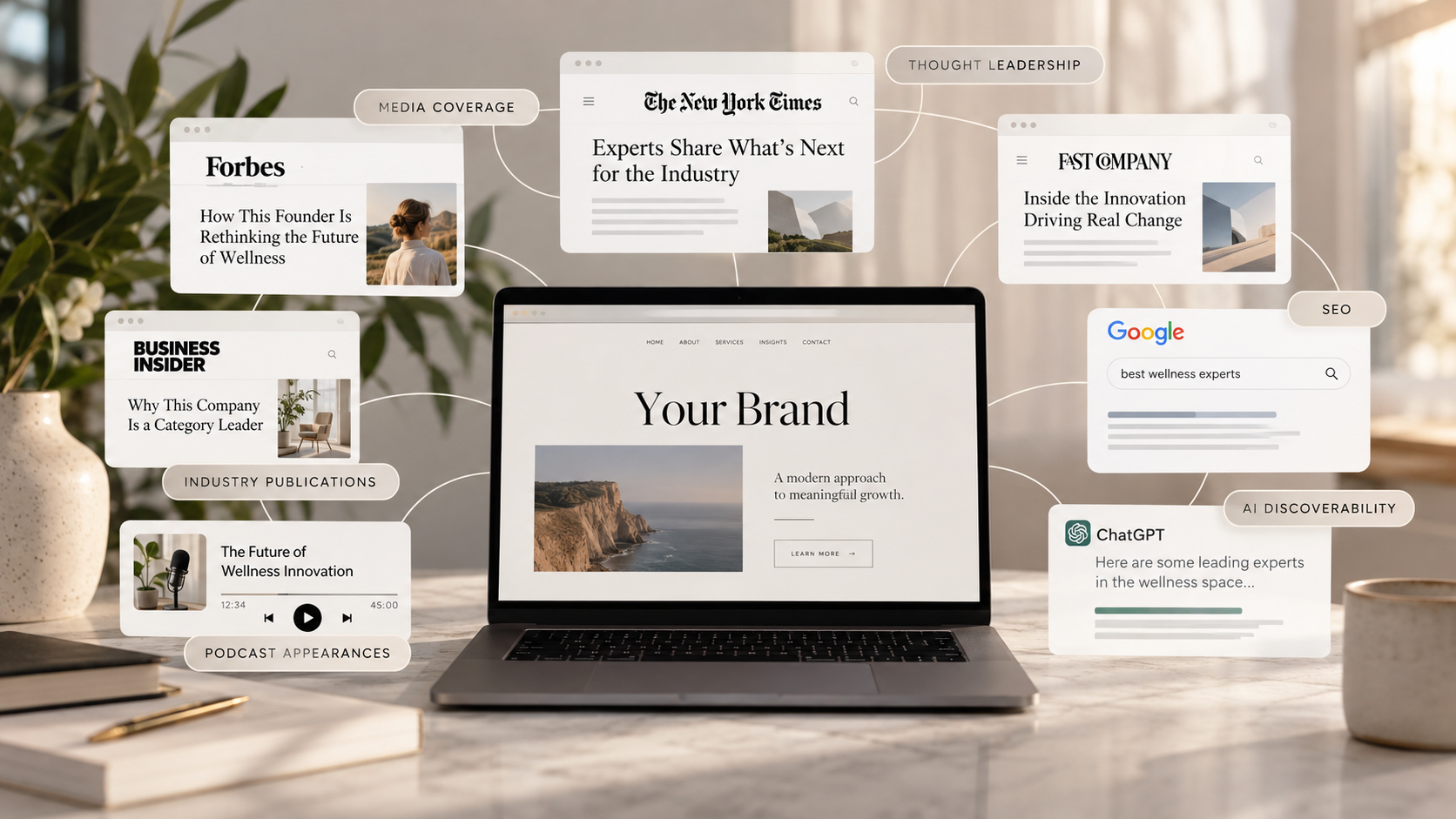
An editorial-style workspace illustrating how brands build authority beyond their websites through media coverage, thought leadership, industry publications, podcasts, SEO, and AI discoverability.
Your website is the foundation of your brand. It tells people who you are, what you do, and why your business matters. But if your website is the only place communicating your expertise, you're missing an important opportunity to build credibility.
Today, people discover and evaluate businesses across a much broader digital landscape. They read media coverage, search for expert opinions, listen to podcasts, explore industry publications, and increasingly use AI-powered tools to research brands, services, and solutions.
That means building brand authority requires more than publishing content on your own website. It requires creating a consistent, credible presence across the places where your audience looks for information.
Public relations (PR), thought leadership, search engine optimization (SEO), and AI discoverability can all contribute to that effort.
The goal isn't simply to make your brand visible. It's to help people understand what your business knows, what it stands for, and why it deserves their attention.
What Is Brand Authority?
Brand authority is the recognition and credibility a business develops within a particular area of expertise.
An authoritative brand isn't simply one that claims to be a leader. It's one that consistently demonstrates its knowledge, offers valuable perspectives, and earns recognition from relevant audiences and credible third-party sources.
For example, a healthcare company might build authority through expert commentary in health publications, original research, interviews with its leadership team, and educational content addressing questions its audience cares about.
A technology company might establish authority through founder interviews, contributed articles, podcast appearances, product innovation stories, and media coverage explaining its perspective on an emerging industry trend.
In both cases, the objective is similar: to create a clear association between the brand and the subjects it wants to be known for.
Brand authority is built through what you communicate about yourself and the credible information that exists about you elsewhere.
Why Your Website Isn't Enough to Build Brand Authority
Your website gives you control over your messaging, positioning, and content. It's where you can explain your services, publish insights, showcase results, and help potential customers understand your business.
But your own website represents your perspective on your brand.
Third-party coverage, independent commentary, industry recognition, and expert interviews can provide additional context that audiences may use when evaluating your credibility.
Think about how someone researches a company before deciding to work with it. They might visit its website, search for its founder, read an article featuring its expertise, or look for independent reviews and recommendations.
Each of these touchpoints can contribute to their understanding of the business.
This is why brand authority should extend beyond your owned channels. When your website, media coverage, thought leadership, and other credible sources reinforce a consistent area of expertise, they create a more complete picture of your brand.
The objective isn't to be mentioned everywhere. It's to show up in relevant places, with a clear message, for the right reasons.
6 Ways to Build Brand Authority Beyond Your Website
1. Earn Media Coverage in Relevant Publications
Earned media is one of the most valuable ways to introduce your expertise to audiences beyond your existing network.
When a journalist quotes your founder, interviews your executive team, or includes your product in a relevant story, your brand has an opportunity to reach readers who may not have encountered it otherwise.
Media coverage can also provide third-party context for your expertise. Rather than relying exclusively on your own content to explain why your business matters, you can point to independent editorial coverage that features your knowledge, perspective, or work.
However, the value of a placement isn't determined by publication name alone.
A feature in a highly relevant industry publication may be more useful than a mention in a larger outlet that reaches the wrong audience or has little connection to your positioning.
When developing a PR strategy, consider:
Audience relevance: Does the publication reach the people you want to influence?
Subject relevance: Does the story reinforce what you want your brand to be known for?
Credibility: Does the coverage provide meaningful context for your expertise?
Discoverability: Can the article help people encounter your brand when researching a relevant topic?
Longevity: Is the article likely to remain accessible and useful after it publishes?
The strongest media strategies prioritize meaningful coverage that supports a larger business objective, rather than pursuing placements simply to increase the total number of press hits.
2. Build Thought Leadership Around Your Expertise
Thought leadership helps establish what your brand knows and how it thinks.
It goes beyond sharing company updates or promoting products. Effective thought leadership offers a distinct perspective on an industry challenge, emerging trend, customer problem, or change in the market.
Founders and executives are often well positioned to contribute because they can draw on firsthand experience, original observations, and decisions they've made while building a business.
That expertise can become the foundation for:
Contributed articles in industry publications
Expert commentary in the media
Podcast interviews
LinkedIn posts and professional discussions
Original research and data-driven insights
Educational articles on your website
The key is consistency around a recognizable subject area.
If your company wants to be known for innovation in healthcare technology, for example, your thought leadership should repeatedly demonstrate relevant knowledge of healthcare challenges, technology adoption, and the needs of the people your business serves.
Over time, this creates a clearer connection between your brand and its areas of expertise.
A strong thought leadership strategy also gives PR efforts more to work with. Rather than pitching a founder with a general company biography, you can offer journalists a specific point of view that contributes to a larger conversation.
3. Create a Consistent Body of Content Around What You Want to Be Known For
Your website still plays an essential role in building authority. The opportunity is to make its content work alongside your external visibility.
Start by identifying the topics most closely connected to your business, expertise, and commercial goals.
Then develop useful content that answers the questions your audience is actually asking.
For example, a B2B technology company might publish articles explaining industry challenges, comparing approaches to a common problem, and offering practical guidance for decision-makers. A health and wellness brand might address consumer questions, explain emerging research, and provide expert perspectives on relevant topics.
This approach can include:
In-depth educational articles
Answers to frequently asked customer questions
Founder and executive insights
Case studies demonstrating your experience
Original research or proprietary data
Supporting articles that link to relevant service pages
The objective is not to publish as much content as possible. It's to create a useful, connected body of information that demonstrates your expertise and helps audiences understand your value.
Your content should also reinforce your external PR efforts. If your founder is quoted in an article about a particular industry trend, related website content can give interested readers more information about your perspective and experience.
This creates a stronger connection between the attention you earn and the information you control.
4. Connect PR and SEO
PR and SEO have traditionally been treated as separate disciplines. But they can support the same broader goal: helping people discover and learn about your brand.
SEO helps make your website's content more accessible and relevant to people searching for information. PR can introduce your expertise to new audiences and create opportunities for credible third-party mentions and links.
When a publication links to your website, that backlink may contribute to your site's search authority, depending on factors such as the source, context, and link attributes. Even when an article doesn't include a link, a relevant brand mention can still provide visibility and help readers discover your business.
PR can support SEO through:
Editorial backlinks from relevant publications
Increased branded searches and awareness
Referral traffic from media coverage
Greater exposure for your experts and key topics
Opportunities to strengthen content through internal links
Additional third-party references to your brand
These outcomes aren't automatic. Not every media placement generates a backlink, increases rankings, or drives measurable website traffic. Results depend on the coverage earned, the relevance of the source, your website, and other factors.
The important point is that PR and SEO don't have to operate independently. A coordinated strategy can help your brand build visibility both on your website and across the broader web.
5. Think About AI Discoverability
People increasingly use AI-powered tools to research companies, explore products, compare services, and find experts.
This adds another consideration to brand visibility: what information is available about your business across the web, and how clearly does that information communicate your expertise?
AI-powered search and answer tools may draw on a range of sources when generating responses. Their sources and selection processes vary, and no PR strategy can guarantee that a brand will be mentioned or recommended.
Still, it makes sense to build a clear, credible digital presence.
That includes maintaining accurate information on your website, publishing useful content, developing recognizable expertise, and earning relevant third-party coverage.
For example, if you want your business to be associated with a specific area of expertise, consider whether that association is reflected consistently across your service pages, articles, media interviews, contributed content, and professional profiles.
The goal isn't to manipulate AI systems or chase a particular algorithm. It's to make your expertise clear and create more opportunities for people to discover credible information about your brand.
AI discoverability is not a replacement for SEO or PR. It's another reason to think strategically about how your brand appears across the digital landscape.
6. Amplify Your Media Coverage Instead of Letting It Sit on a Shelf
Earning media coverage is an important milestone, but it doesn't have to be the end of the process.
A published article can become a starting point for additional visibility across your owned channels.
For example, after a founder interview or expert feature publishes, you might:
Share the coverage on LinkedIn with a relevant insight from the article.
Add the placement to your website's press or media highlights page.
Link to it from a relevant case study or service page.
Incorporate the coverage into a sales presentation or credentials deck.
Develop a follow-up article that expands on the topic.
Use the placement as context for future media pitches.
Always follow the publication's usage and attribution requirements when sharing its content.
Amplification helps more of your existing audience encounter the coverage and makes it easier to connect the placement to your broader expertise.
It also helps ensure your PR efforts contribute to a consistent brand narrative rather than becoming a collection of disconnected media mentions.
How to Build a Brand Authority Strategy
Building authority is more effective when each activity supports a clear objective. Before investing in more content or outreach, establish what you want your brand to be known for.
Step 1: Identify Your Core Areas of Expertise
Choose the subjects most relevant to your business, customers, and long-term positioning.
You don't need to comment on every industry trend. Focus on the topics where your experience, perspective, and services give you a meaningful contribution to make.
Step 2: Audit Your Existing Digital Presence
Review your website, search results, media coverage, executive profiles, and existing thought leadership.
Ask yourself:
Is it clear what our brand does and who we serve?
Are our key areas of expertise easy to identify?
Does our external coverage reinforce the same positioning?
Are there important questions our content doesn't answer?
Are our media mentions and relevant articles easy to find?
This audit can reveal gaps between how you want to be perceived and what people can currently discover about your business.
Step 3: Develop a PR and Content Plan
Identify opportunities to demonstrate your expertise through a combination of media outreach, thought leadership, website content, and relevant industry conversations.
Your plan should connect individual activities to your broader positioning. For example, if you want your founder to become a recognized voice on a particular industry issue, prioritize media angles, contributed articles, and content that consistently reinforce that expertise.
Step 4: Measure More Than Media Placements
The number of articles published is one measure of PR activity, but it doesn't tell the whole story.
Depending on your objectives, you might also track:
Quality and relevance of media placements
Backlinks and referring domains earned
Referral traffic from coverage
Branded search trends
Engagement with thought leadership
Relevant inbound inquiries
Whether your intended areas of expertise are becoming more visible across credible sources
AI visibility can also be monitored, but results may vary by tool, query, location, and time. Treat these observations as directional signals rather than a guaranteed measure of authority.
The most useful metrics are the ones that connect your communications activity to your actual business goals.
Why Brand Authority Matters for Long-Term Growth
Brand authority isn't built through one article, one interview, or one campaign. It's developed over time through consistent expertise, credible visibility, and meaningful interactions with your audience.
When your website communicates a clear message, your thought leadership demonstrates your perspective, and relevant media coverage reinforces your expertise, you give people more ways to understand what makes your business valuable.
That can support brand recognition, strengthen your credibility, and create additional opportunities for discovery.
It also changes the way you think about PR.
Instead of evaluating every placement as an isolated win, you can ask a more strategic question: What is this activity helping our brand become known for?
That question connects individual media opportunities to a larger business objective.
At Fein PR, this is how we approach modern public relations: combining earned media, thought leadership, SEO-driven PR, and AI discoverability to help brands build authority beyond their own websites.
Because the goal isn't just to get your brand mentioned.
It's to build a credible, recognizable presence around what your business knows and wants to be known for.
Your website is the foundation. Your brand authority is built across the web.
Frequently Asked Questions
How do you build brand authority online?
Build brand authority by communicating a clear area of expertise across your website, earned media, thought leadership, industry publications, and other relevant channels. Consistency, credibility, and relevance matter more than simply producing a high volume of content.
Does PR help build brand authority?
Yes. PR can help build brand authority by placing your expertise in front of relevant audiences and creating opportunities for third-party recognition. Media coverage, expert commentary, and interviews can reinforce what your brand is known for, particularly when they support a consistent positioning strategy.
What is the difference between brand awareness and brand authority?
Brand awareness refers to whether people recognize or know about your brand. Brand authority goes further: it concerns whether your business is recognized as a credible source of expertise within a particular subject area. PR can support both, but awareness alone doesn't necessarily establish authority.
How does brand authority relate to SEO?
SEO helps people discover relevant content through search engines. Brand authority can be supported by useful website content, relevant backlinks, credible media mentions, and consistent expertise. PR and SEO can work together, although media coverage does not automatically improve search rankings.
Can brand authority help with AI discoverability?
A clear website, useful content, and relevant third-party coverage can create more opportunities for AI-powered tools to encounter information about your brand. However, AI systems vary in how they retrieve and present information, so no approach guarantees inclusion in AI-generated answers.
Build Brand Authority With Fein PR
If your business is ready to move beyond one-off media placements and build a more consistent presence across media, search, and thought leadership, Fein PR can help.
Fein PR works with brands and experts to develop strategic PR programs that connect earned media, founder visibility, SEO, and AI discoverability to a clear positioning strategy.
Explore our PR services, learn about our thought leadership approach, or see how we've supported brands through our client case studies.