
How to Build Brand Authority Beyond Your Own Website
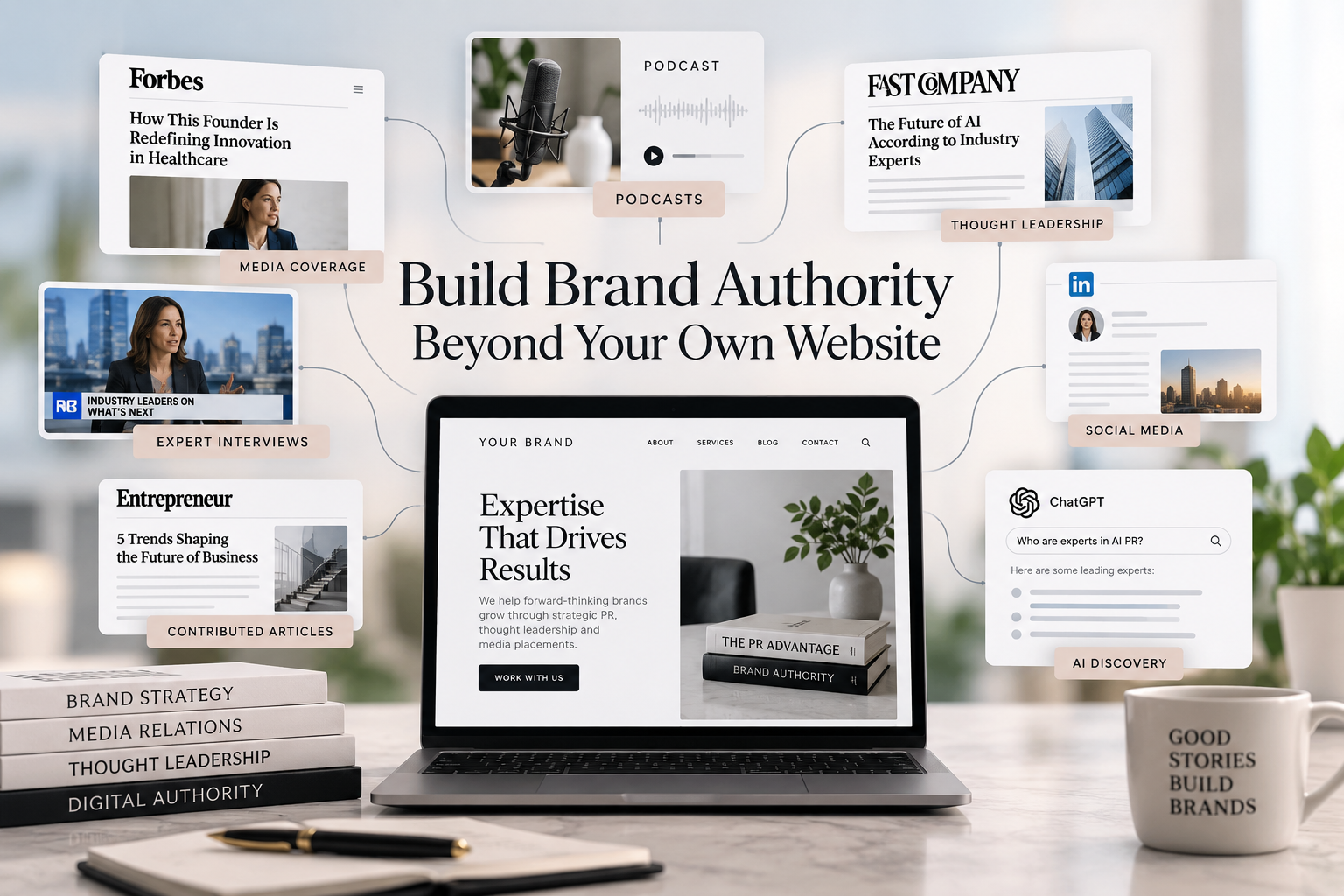
A laptop displaying a brand website surrounded by media coverage, thought leadership, podcasts, social media and AI search results, illustrating how businesses can build brand authority beyond their own website
Your website is one of the most important assets your brand owns.
It explains what you do. It showcases your services or products. It gives people a place to learn about your company and, ideally, take the next step.
But there is a limit to what your own website can do.
You can say you're an expert.
You can publish dozens of blog posts.
You can describe your company as a leader in your industry.
But your website is still your own platform talking about you.
Brand authority becomes much stronger when credible information about your company, founders and expertise exists beyond your own website.
That's where PR, thought leadership, earned media and third-party visibility come in.
What Is Brand Authority?
Brand authority is the level of credibility and recognition your brand has within a particular area of expertise.
It's not simply about being well known.
A company can have a large social following and still not be considered an authority on a particular subject.
Authority is about becoming associated with something.
For example, you might want your company to be known for:
Artificial intelligence
Healthcare innovation
Women's health
Cosmetic dentistry
Sustainable design
Financial technology
Entrepreneurship
Wellness
The goal is to consistently demonstrate expertise and credibility around those subjects.
And increasingly, that credibility is being built across the web—not just on your own website.
Your Website Is the Foundation, Not the Entire Strategy
Your website should clearly communicate who you are, what you do and what you know.
That means having strong service or product pages, useful educational content, clear information about your team and expertise, and content that answers the questions your audience is actually asking.
But imagine two companies.
Company A
Its website says:
"We are a leading healthcare technology company."
It has a few blog posts and a handful of product pages.
Company B
Its website says the same thing—but its founders have also:
Been interviewed by healthcare publications
Contributed expert commentary
Appeared on industry podcasts
Been quoted in relevant articles
Published research or insights
Spoken at industry events
Earned coverage in business and healthcare media
The second company has something the first doesn't:
A body of information outside its own website supporting its expertise.
That's where brand authority starts to become much more powerful.
Why Third-Party Credibility Matters
Anyone can make a claim about their own business.
That's why third-party validation matters.
When an independent publication interviews your founder, quotes your expert or covers your company, the information isn't coming solely from your own marketing channels.
That doesn't mean every media mention automatically makes a company authoritative.
Relevance matters.
Credibility matters.
Consistency matters.
The goal is to build a collection of credible, relevant third-party signals that reinforce what you want your brand to be known for.
For example, if your company wants to become known for AI innovation, coverage in a relevant technology publication is much more meaningful than an unrelated mention simply because the publication has a large audience.
The question isn't just:
"Did we get coverage?"
It's:
"What does this coverage help us become known for?"
Earned Media Can Extend Your Brand Beyond Your Website
One of the biggest advantages of earned media is that it puts your expertise into conversations that already exist.
Instead of publishing another article on your own website saying you're an expert, your founder might be quoted by a journalist discussing an emerging industry trend.
That creates another place where your expertise exists online.
Earned media opportunities can include:
Expert commentary
Interviews
Founder profiles
Industry trend stories
Product coverage
Contributed articles
Podcasts
Broadcast appearances
Industry publications
Over time, those individual opportunities can become something much bigger:
a recognizable digital footprint around your expertise.
Thought Leadership Helps People Associate You With Something
Thought leadership is another way to build authority beyond your website.
The goal isn't simply to have a founder publish opinions.
Strong thought leadership gives people a reason to associate that person or brand with a particular area of expertise.
That might happen through:
LinkedIn posts
Media commentary
Contributed articles
Podcast interviews
Speaking opportunities
Industry panels
Expert quotes
Original research
Educational content
The key is consistency.
If a founder talks about AI one week, real estate the next and wellness the following week, it becomes harder to establish a clear area of expertise.
But when their insights consistently contribute to the same broader conversation, recognition can begin to build.
Don't Just Build a Library of Content. Build a Network of Information.
This is an important distinction.
A strong content strategy isn't necessarily about publishing more and more articles on your own website.
It's about creating a connected ecosystem of information.
Your website might explain your expertise.
A podcast might feature your founder discussing it.
A journalist might quote your founder on the same subject.
A trade publication might publish their perspective.
Your LinkedIn account might expand on the conversation.
Another publication might interview them six months later about a related trend.
Each individual piece has value.
But together, they create something much stronger:
a broader digital presence around what you know.
PR and SEO Work Better Together
This is also where PR and SEO increasingly intersect.
Your website provides the foundation for your search strategy.
But earned media can help expand the number of places where your brand appears online.
Relevant coverage may create:
Backlinks
Brand mentions
Referral traffic
Expert citations
New branded search opportunities
Additional pages connecting your name or company to relevant topics
The objective isn't simply to collect backlinks.
It's to build relevant digital authority.
A high-quality mention in a publication that covers your industry can be more strategically valuable than dozens of unrelated links.
That's why SEO-driven PR should focus on relevance and authority rather than volume alone.
Brand Authority Is Also Becoming Important for AI Discovery
There is another reason this matters.
People are increasingly using AI-powered tools to research companies, experts, products and services.
Instead of only searching:
"best PR agency for healthcare"
someone might ask an AI platform:
"Who are some PR firms that specialize in healthcare and thought leadership?"
Or:
"Who are experts in cosmetic dentistry?"
Or:
"What companies are known for AI-powered travel?"
The more credible and relevant information that exists across the web about a brand or expert, the more context there is for those systems to understand what that brand does and what it may be associated with.
That doesn't mean media coverage guarantees that a company will appear in ChatGPT or another AI platform.
It means building a strong digital footprint gives your brand more opportunities to be understood and discovered.
And that's becoming an increasingly important part of modern PR.
What Should You Build Authority Around?
Before you start pitching media or publishing thought leadership, decide what you actually want to be known for.
Ask:
What subject do we want people to associate with our brand?
What expertise do we have that is genuinely valuable?
What conversations do we have something meaningful to contribute to?
What questions are our customers asking?
What topics do we want journalists to call us about?
Those answers should shape your PR and content strategy.
For example, a healthcare founder might decide to build authority around women's health innovation.
A technology founder might focus on the future of AI in the workplace.
A cosmetic dentist might focus on minimally invasive aesthetic dentistry and natural-looking results.
The clearer the area of expertise, the easier it becomes to build consistent recognition around it.
Think Beyond the Individual Placement
One of the biggest mistakes brands make with PR is treating every placement as an isolated win.
The article publishes.
The team shares it on social media.
Then everyone moves on.
Instead, ask:
What can we build from this?
A media interview can become a LinkedIn post.
A journalist's question can inspire a blog article.
A podcast conversation can become a short video.
A contributed article can support a larger thought-leadership platform.
A media placement can become part of your sales materials.
A strong story can lead to another pitch.
The placement isn't necessarily the end of the PR opportunity.
It can be the beginning of the next one.
Build Authority Where Other People Are Already Looking
Ultimately, brand authority isn't something you can create entirely by talking about yourself.
Your website matters.
Your own content matters.
Your social channels matter.
But your brand becomes more credible when your expertise also exists in the places where other people are already looking for information.
That means showing up in:
Relevant media
Industry publications
Podcasts
Expert interviews
Search results
Social conversations
Industry events
Third-party articles
AI-powered discovery experiences
The goal isn't to be everywhere.
It's to be in the right places consistently.
The Bottom Line
Your website should be the foundation of your digital presence.
But it shouldn't be the entire story.
The strongest brands build authority across an ecosystem of owned, earned and third-party channels.
Your website tells people what you know.
Your content demonstrates your expertise.
Your social presence gives you a platform to share your perspective.
And earned media and third-party visibility provide opportunities for other credible sources to validate and amplify that expertise.
Because ultimately, brand authority isn't built by saying you're an expert.
It's built by consistently creating credible evidence that you are.
And in an increasingly search- and AI-driven world, that evidence shouldn't live in just one place.
It should exist across the web.