
How to Get Your Brand Discovered in ChatGPT
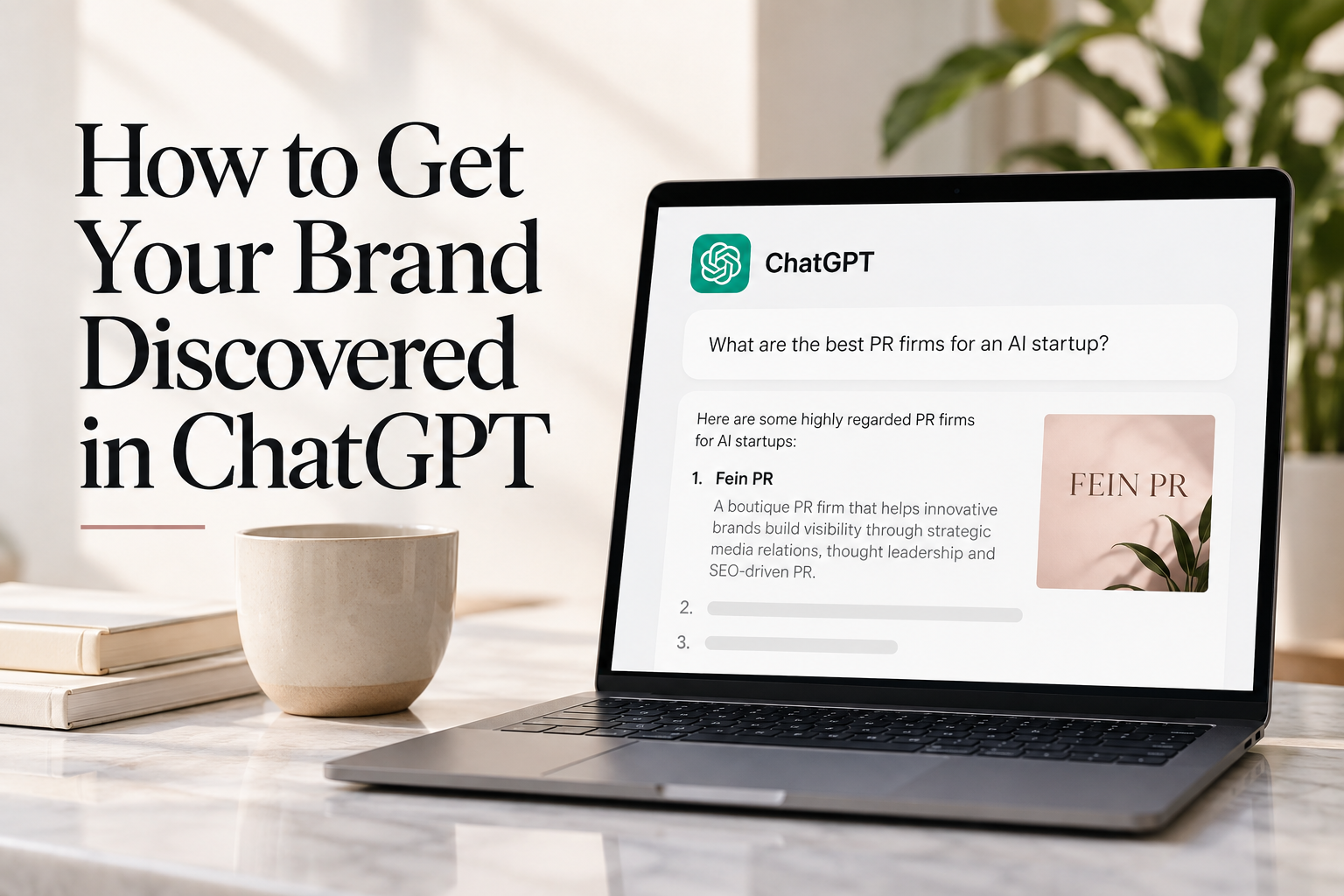
A modern PR workspace featuring a laptop displaying an AI search conversation about finding PR firms, illustrating how brands can become discoverable in ChatGPT and AI-powered search.
If someone asked ChatGPT to recommend a brand, company, expert or service provider in your industry, would your name come up?
For many businesses, the answer is still no.
And that raises a bigger question: How do you actually get your brand discovered in ChatGPT and other AI-powered search experiences?
The answer isn't simply adding more keywords to your website or trying to “optimize” your brand specifically for ChatGPT.
AI-powered platforms increasingly rely on information from across the web to understand companies, people, products and areas of expertise. That means the brands with the strongest opportunity to be discovered are often the ones that have built a consistent, credible body of information around who they are and what they are known for.
That is where PR, thought leadership, SEO and content begin to work together.
What Does It Mean to Be Discovered in ChatGPT?
Traditional search typically starts with someone typing a query into Google and receiving a list of links.
AI-powered discovery can work differently.
Instead of searching for a specific website, someone might ask:
“Who are the best PR firms for an AI startup?”
“Who are experts in cosmetic dentistry?”
“What companies specialize in women's health?”
“Who should I talk to about SEO-driven PR?”
“What PR firms work with healthcare brands?”
The user isn't necessarily looking for your website.
They're asking a question.
That changes the visibility equation for brands.
The goal is no longer only to rank for a keyword. It's also to build enough relevant, credible information online that your brand can be understood and potentially surfaced when someone asks a question related to what you do.
You Can't Simply “Submit” Your Brand to ChatGPT
One of the biggest misconceptions about AI discoverability is that there is a simple submission form or optimization trick that guarantees your brand will appear.
There isn't.
You can't simply tell ChatGPT, “Recommend my company,” and expect it to happen.
And you shouldn't think of AI discoverability as a replacement for SEO.
Instead, think about the bigger picture:
What information exists online about your brand?
Is your website clear about what you do?
Are credible third-party publications mentioning you?
Are experts from your company contributing to relevant conversations?
Are you consistently publishing useful information?
Are different sources connecting your name or company with the subjects you want to be known for?
Those signals can help create a much clearer digital footprint.
Start With What You Want to Be Known For
Before thinking about ChatGPT, start with a more fundamental question:
What do you want your brand to be known for?
This is one of the most important questions in modern PR.
A company shouldn't try to become known for everything.
If you're a healthcare company, perhaps you want to build authority around a particular area of healthcare.
If you're a technology company, perhaps you want to be associated with a specific category or innovation.
If you're a founder, perhaps you want to become known for a particular area of expertise.
Your content, media coverage and thought leadership should consistently reinforce those associations.
For example, a founder who wants to be known as an expert in AI shouldn't only publish company announcements.
They could:
Write about trends in AI
Contribute expert commentary to relevant publications
Participate in industry interviews
Appear on podcasts
Publish educational content on their website
Share informed perspectives on LinkedIn
Earn coverage in relevant business and technology media
Over time, those activities create a broader body of information connecting that person with AI.
Build a Website That Clearly Explains Your Expertise
Your website is still foundational.
AI discoverability doesn't mean your own website suddenly doesn't matter.
In fact, your website should make it extremely clear:
Who are you?
What do you do?
Who do you serve?
What subjects do you have expertise in?
What problems do you solve?
Your service pages should be specific rather than vague.
Instead of simply saying “We offer PR services,” a page could clearly explain your expertise in areas such as healthcare PR, technology PR, thought leadership or SEO-driven PR.
Your blog can then expand on those topics.
This creates a connected ecosystem of information rather than a website containing a handful of disconnected pages.
Create Content Around the Questions Your Audience Actually Asks
One of the biggest opportunities with AI search is that people are asking questions, not just searching keywords.
That means your content strategy should account for natural-language questions.
For example, instead of only targeting:
“AI PR agency”
you might create useful content around questions such as:
How does PR help AI startups build credibility?
How can PR support AI discoverability?
What should an AI startup look for in a PR firm?
The goal isn't to stuff those questions into your website.
It's to actually answer them well.
That distinction matters.
Earn Third-Party Media Coverage
This is where PR becomes particularly important.
Your website can tell people that you're an expert.
But third-party publications can provide independent evidence that other people recognize your expertise.
That might include:
Expert commentary
Interviews
Contributed articles
Podcasts
Industry publications
Business media
News coverage
Founder profiles
Relevant product or company coverage
The objective isn't simply to collect as many links as possible.
It's to build credible associations between your brand and the topics you want to own.
For example, if you want to be known for healthcare expertise, five unrelated articles may not accomplish as much as several relevant pieces of coverage that consistently connect your expertise to healthcare.
Thought Leadership Matters More Than Ever
Thought leadership is another piece of the AI discoverability puzzle.
When your name consistently appears alongside useful insights about a particular subject, you're creating more information that helps establish your expertise.
That can happen through:
Media commentary
LinkedIn content
Articles
Podcasts
Interviews
Speaking opportunities
Industry publications
Your own website
And these channels can reinforce each other.
A media interview can become a LinkedIn post.
A podcast can become a blog topic.
A contributed article can lead to another interview.
A client story can become a broader industry perspective.
One piece of expertise can create multiple opportunities for visibility.
PR and SEO Shouldn't Operate Separately
This is where modern PR gets particularly interesting.
Traditional PR might ask:
“Can we get coverage?”
SEO might ask:
“Can we rank for this keyword?”
AI discoverability adds another question:
“What information is available online that helps people—and AI systems—understand who we are and what we know?”
Those questions can work together.
A strong PR placement can generate a backlink.
A thought leadership article can create another third-party mention.
A media interview can reinforce a particular area of expertise.
Your website can provide additional depth on that subject.
The result is a network of information, rather than a single piece of content working in isolation.
Don't Focus on Gaming AI
This may be the most important point.
The goal shouldn't be to figure out how to trick ChatGPT into mentioning your company.
Instead, build a brand that has something worth discovering.
That means:
Publish genuinely useful information.
Develop real expertise.
Get your experts into relevant conversations.
Earn credible media coverage.
Build a clear website.
Create content around your areas of expertise.
Be consistent.
In other words, build authority first.
Discoverability can follow.
I’m Seeing This Happen With My Own PR Business
I've experienced this firsthand with Fein PR.
I've recently had multiple prospective clients tell me they found my PR firm through ChatGPT when they were looking for a PR firm or researching PR.
What's interesting is that I haven't been trying to “get into ChatGPT.”
I've been consistently building Fein PR's digital presence through:
Thought leadership
SEO-focused website content
Blog content
Sharing my expertise
Content around PR, SEO and AI discoverability
Seeing prospective clients actually find me through AI has made the connection much more tangible.
It's one thing to talk about AI discoverability as a marketing concept.
It's another thing to have someone say:
“I found you through ChatGPT.”
And that's exactly why I believe the future of PR is becoming increasingly connected to discoverability.
The Future of Brand Discovery Is Bigger Than Google
For years, brands have focused on one fundamental question:
Can people find us on Google?
Now there's another question worth asking:
Can people discover us when they ask a question?
That doesn't mean traditional SEO is going away.
It means the definition of digital visibility is expanding.
People are searching through traditional search engines, social platforms, recommendation engines and increasingly AI-powered tools.
Brands need to think beyond individual rankings and individual media placements and start building a consistent body of credible information around what they want to be known for.
That's where PR becomes more than publicity.
It becomes part of a broader authority and discoverability strategy.
The Bottom Line
You don't need to “hack” ChatGPT to get discovered.
You need to give the digital ecosystem enough clear, relevant and credible information to understand your brand.
Build your website.
Create useful content.
Share your expertise.
Earn relevant media coverage.
Develop thought leadership.
Build authority around the subjects you want to be known for.
Because modern PR isn't just about getting your brand seen.
It's about making your brand discoverable.