
What Actually Gets PR Coverage in 2026 (Beyond Traditional Pitches)
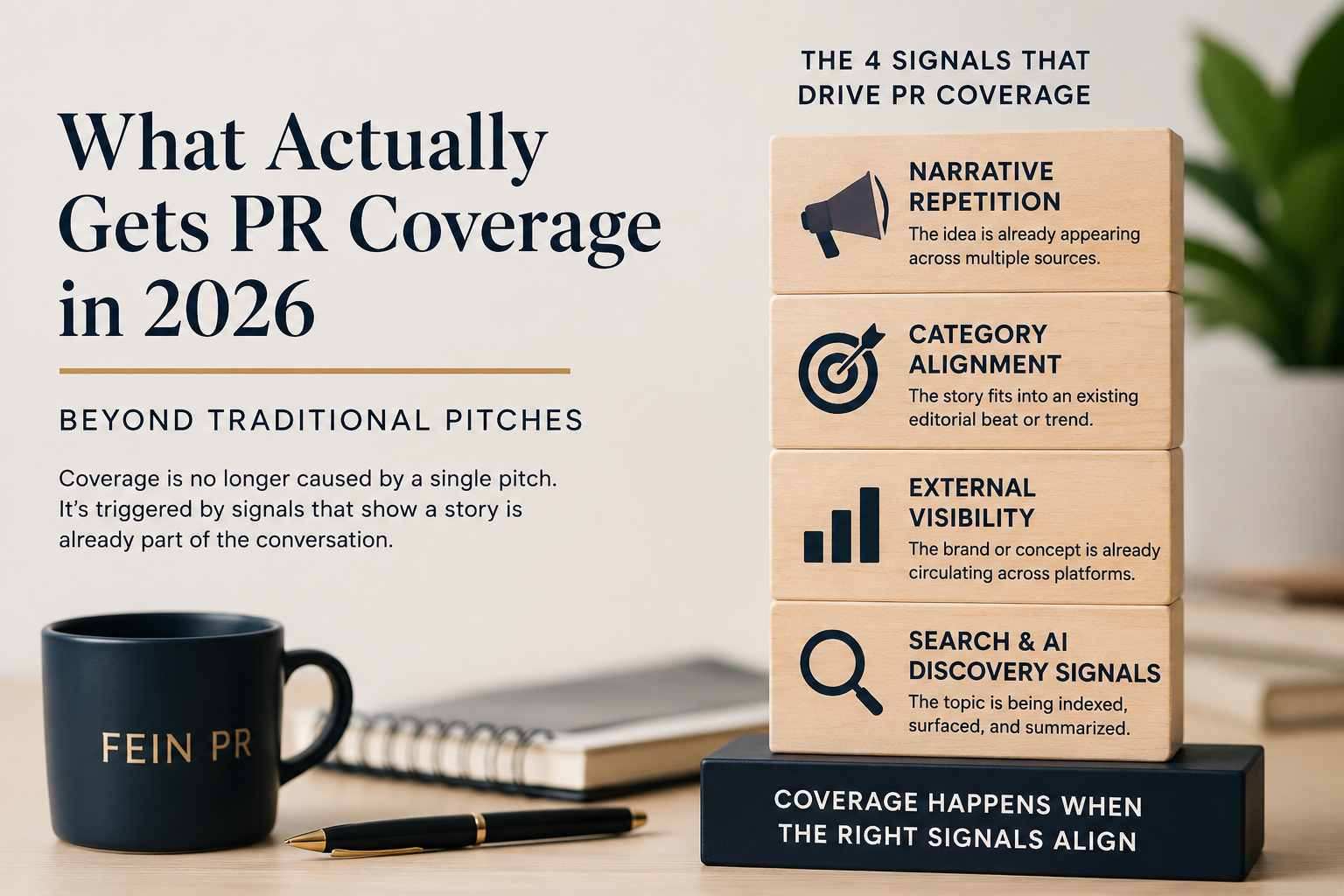
Visual showing how PR coverage in 2026 is driven by narrative momentum, SEO visibility, and cross-platform signals rather than standalone pitching, with media coverage emerging from a connected system of repeated exposure.
Most PR pitches don’t fail because the idea is weak.
They fail because they are not aligned with how coverage is actually generated anymore.
In 2026, media coverage is no longer triggered by a single email or a perfectly crafted pitch. It is triggered by patterns — repeated signals that show a story already exists within the broader media ecosystem.
At Fein PR, we see this constantly: the brands that get covered are not always the ones pitching the most, but the ones already showing up in the right narrative environments.
Coverage is no longer a direct response to outreach
Traditional PR assumes a simple model:
Pitch → Journalist reads → Coverage happens
But this model no longer reflects how modern editorial systems work.
Today, coverage is influenced by:
existing narrative momentum
category-level trends already in circulation
audience engagement signals
and prior reinforcement of similar ideas across platforms
A pitch is not evaluated alone — it is evaluated against everything already competing for attention.
The real question behind coverage has changed
Instead of asking:
“Is this a good story?”
Editors are increasingly asking:
“Is this already becoming a story people care about?”
This shift is the foundation of modern PR strategy.
It means coverage is less about persuasion and more about readiness within a narrative system.
This is exactly how we approach strategy inside Boutique PR services at Fein PR
The 4 signals that actually drive PR coverage in 2026
Across modern media ecosystems, coverage tends to emerge when these signals are present:
1. Narrative repetition
The idea is already appearing across multiple sources.
2. Category alignment
The story clearly fits into an existing editorial beat or industry conversation.
3. External visibility
The brand or concept is already circulating across platforms, even lightly.
4. Search + AI discovery signals
The topic is already being indexed, summarized, or surfaced in discovery systems.
These signals matter more than the pitch itself.
This is also where Backlinks & SEO-Driven PR becomes critical
Because visibility is no longer just media-based — it is distributed across search, AI systems, and digital ecosystems.
Why pitching alone is no longer enough
One of the biggest misconceptions in PR is that better outreach leads to better coverage outcomes.
But in reality, outreach is only one small input in a much larger system.
Without narrative presence, even strong pitches fail to convert.
This is why we often see:
strong pitches ignored
weaker stories picked up
unexpected brands gaining coverage momentum
It is not randomness — it is system behavior.
What replaces traditional pitching as the primary driver of coverage
Modern PR relies on pre-pitch visibility systems, not isolated outreach.
This includes:
consistent thought leadership
narrative repetition across platforms
SEO-aligned PR content that builds discoverability
strategic media placements that reinforce one core story
and cross-channel amplification over time
This is the foundation of Thought Leadership strategy at Fein PR
When done correctly, pitching becomes a confirmation step — not the origin point of coverage.
Why some brands get covered without “better pitches”
Brands often appear to get coverage “effortlessly,” but in reality they have already done the underlying narrative work.
By the time a journalist receives their pitch:
the topic already feels familiar
the brand already exists within category context
and the story aligns with ongoing editorial momentum
So the pitch doesn’t need to convince — it only needs to connect.
How this changes modern PR strategy
Effective PR in 2026 is no longer about:
sending more pitches
writing better subject lines
or targeting more journalists
It is about:
building narrative presence before outreach
creating repeated visibility across channels
reinforcing a consistent story over time
and designing PR as a system, not a campaign
This is the same framework used in Fein PR Monthly PR Plan engagements
Where PR is structured as an ongoing visibility engine rather than one-off placements.
Final takeaway
PR coverage in 2026 is not primarily created through pitching.
It is created through narrative readiness and system-wide visibility.
The brands that consistently get featured are not necessarily the ones with the best outreach.
They are the ones that already exist inside the conversation before the pitch is ever sent.
Next steps (for readers)
If you want to implement this system:
Explore Boutique PR services → for full narrative positioning
Explore Thought Leadership → for authority building
Explore Backlinks & SEO-Driven PR → for discoverability + search visibility
Explore Monthly PR Plan → for ongoing execution