
How to Get Featured in Forbes (PR Strategy Explained for 2026)
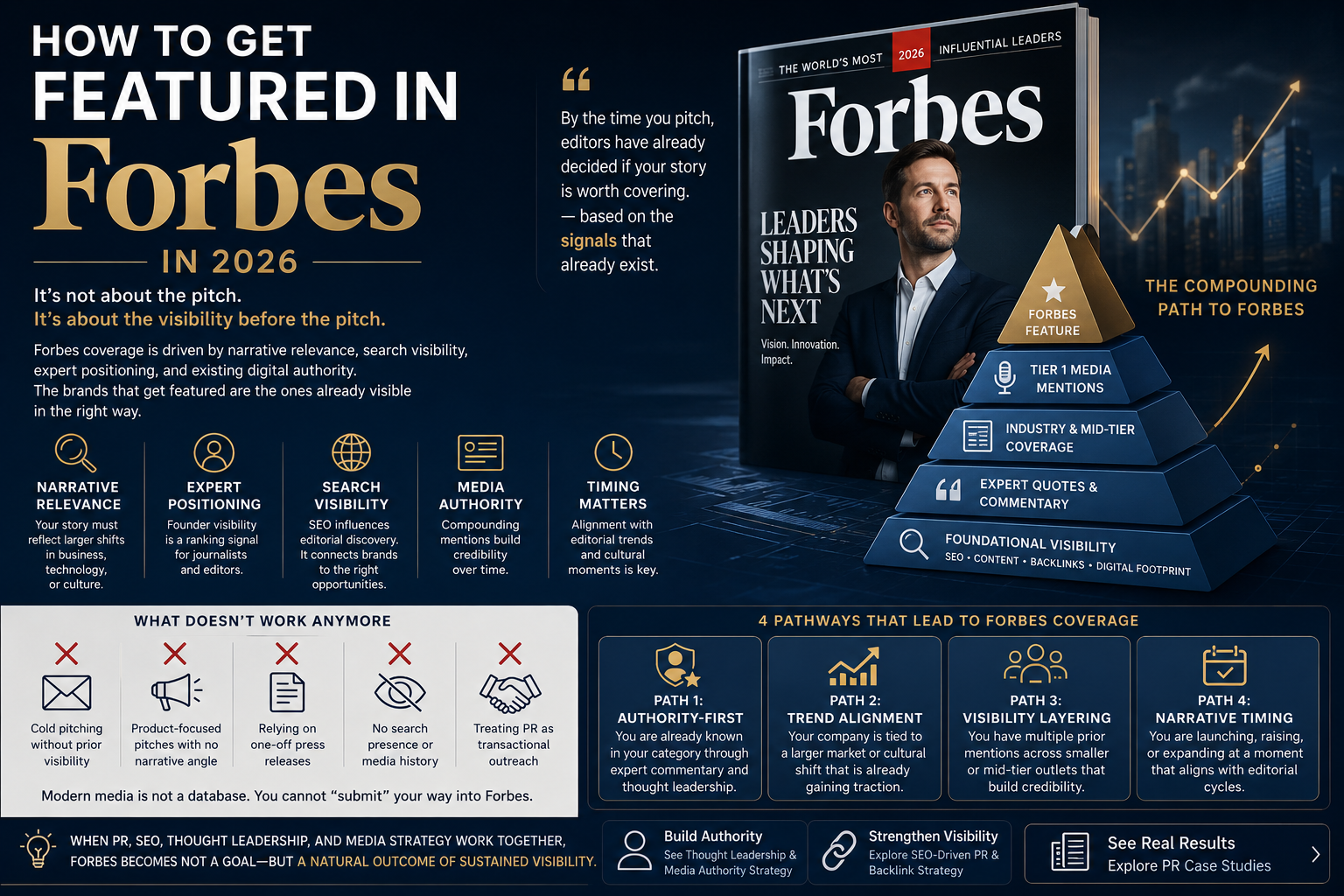
A professional infographic illustrating how brands earn Forbes coverage in 2026 through a combination of PR, SEO, thought leadership, and media visibility. The graphic highlights the progression from foundational digital authority to top-tier media features, emphasizing that sustained visibility—not just a strong pitch—drives modern media success.
Getting featured in Forbes is no longer just about having a great product, funding announcement, or sending a strong pitch. In 2026, Forbes coverage is driven by a combination of narrative relevance, search visibility, expert positioning, and existing digital authority.
The brands that consistently earn coverage aren’t necessarily the most innovative—they’re the most visible in the right way before the pitch is ever sent.
This guide breaks down exactly how to get featured in Forbes today, and what actually determines whether your story gets picked up.
1. Forbes Coverage Starts Before the Pitch
One of the biggest misconceptions in PR is that coverage begins when you send an email.
In reality, editors at Forbes are responding to signals that already exist:
Has the brand been mentioned elsewhere?
Is the founder already visible as an expert?
Does the topic align with current editorial demand?
Is the company already part of a larger cultural or industry conversation?
If the answer is no, even a well-written pitch will struggle.
This is why modern PR is no longer just outreach—it’s visibility engineering before outreach.
2. You Need a Clear “Forbes-Worthy Narrative”
Forbes does not cover companies—they cover stories that reflect larger shifts in business, technology, or culture.
Strong narrative angles usually fall into one of these categories:
Industry disruption (changing how something works)
Founder expertise (why this person should be listened to)
Market timing (why this matters now)
Cultural shift (why consumer behavior is changing)
Category creation (defining something new)
If your story cannot be framed within one of these, it will not scale into Tier 1 media.
This is where strategic positioning matters more than press outreach.
3. Founder Visibility Is a Ranking Signal for Media
In 2026, journalists often evaluate founders before companies.
Before a Forbes feature happens, editors frequently check:
Has the founder been quoted elsewhere?
Do they show up in search results for relevant topics?
Have they contributed expert commentary or thought leadership?
Are they referenced in other publications?
This is why thought leadership is no longer optional for PR—it is infrastructure.
👉 If you want to understand how this builds long-term visibility, see our breakdown of Thought Leadership & Media Authority Strategy
4. SEO + PR Are Now Connected (Not Separate)
One of the biggest shifts in modern media is that SEO influences editorial discovery.
Brands that get featured in Forbes often already have:
Search visibility around their category
Existing media mentions across multiple outlets
Strong backlink profiles from prior coverage
Consistent content around their expertise
This is why SEO-driven PR is now a core part of media strategy, not a separate function.
👉 For a deeper breakdown of this system, see SEO-Driven PR & Backlink Strategy for Modern Brands
5. Media Coverage Is Built Through “Compounding Proof”
Forbes rarely features a brand in isolation. Instead, coverage builds over time through what can be called compounding media proof:
Smaller publications first
Industry-specific coverage
Expert quotes and commentary
Repeat mentions across multiple outlets
Growing search presence
By the time a Forbes editor sees the brand, it already feels established.
This is why single-pitch strategies fail—they ignore the compounding nature of modern media visibility.
6. What Actually Gets You Featured in Forbes
To simplify the modern process, Forbes coverage usually comes from one of these pathways:
Path 1: Authority-First
You are already known in your category through commentary, thought leadership, and expert sourcing.
Path 2: Trend Alignment
Your company is directly tied to a larger market or cultural shift that is already being covered.
Path 3: Visibility Layering
You have multiple prior mentions across smaller or mid-tier outlets that build credibility.
Path 4: Narrative Timing
You are launching, raising, or expanding at a moment that aligns with editorial cycles.
Most successful features combine more than one of these.
7. What Doesn’t Work Anymore
These outdated approaches rarely lead to coverage:
Cold pitching without prior visibility
Sending product-focused announcements with no narrative angle
Relying on one-off press releases
Pitching without prior search or media presence
Treating PR as transactional outreach
Modern media is not a database—you cannot simply “submit” your way into Forbes.
8. The Role of Media Placements in This Process
Once your narrative and authority are in place, execution matters.
Strong media placement strategy focuses on:
Identifying the right journalists and beats
Aligning stories with editorial demand
Building consistent visibility across multiple outlets
Reinforcing authority through repeated mentions
👉 To understand how this process works in practice, explore Media Placements & Press Features Strategy
9. What Strong PR Campaigns Actually Look Like
The brands that consistently earn Forbes coverage usually have:
A defined category or narrative position
Founder-led expertise in public conversation
Ongoing media visibility (not one-time press hits)
Strategic SEO alignment
Supporting coverage across multiple outlets
For example, in our client work, brands that built sustained visibility before pitching saw significantly higher success rates in securing Tier 1 media coverage.
👉 See real examples in our PR Case Studies
Final Takeaway
Getting featured in Forbes in 2026 is not about the pitch itself—it is about everything that happens before the pitch.
If your brand is not already visible, contextualized, and positioned within a larger narrative, the likelihood of coverage is significantly lower.
But when PR, SEO, thought leadership, and media placement strategy work together, Forbes becomes not a goal—but a natural outcome of sustained visibility.