
What Makes a Story Press-Worthy in 2026? (How to Know Before You Pitch)
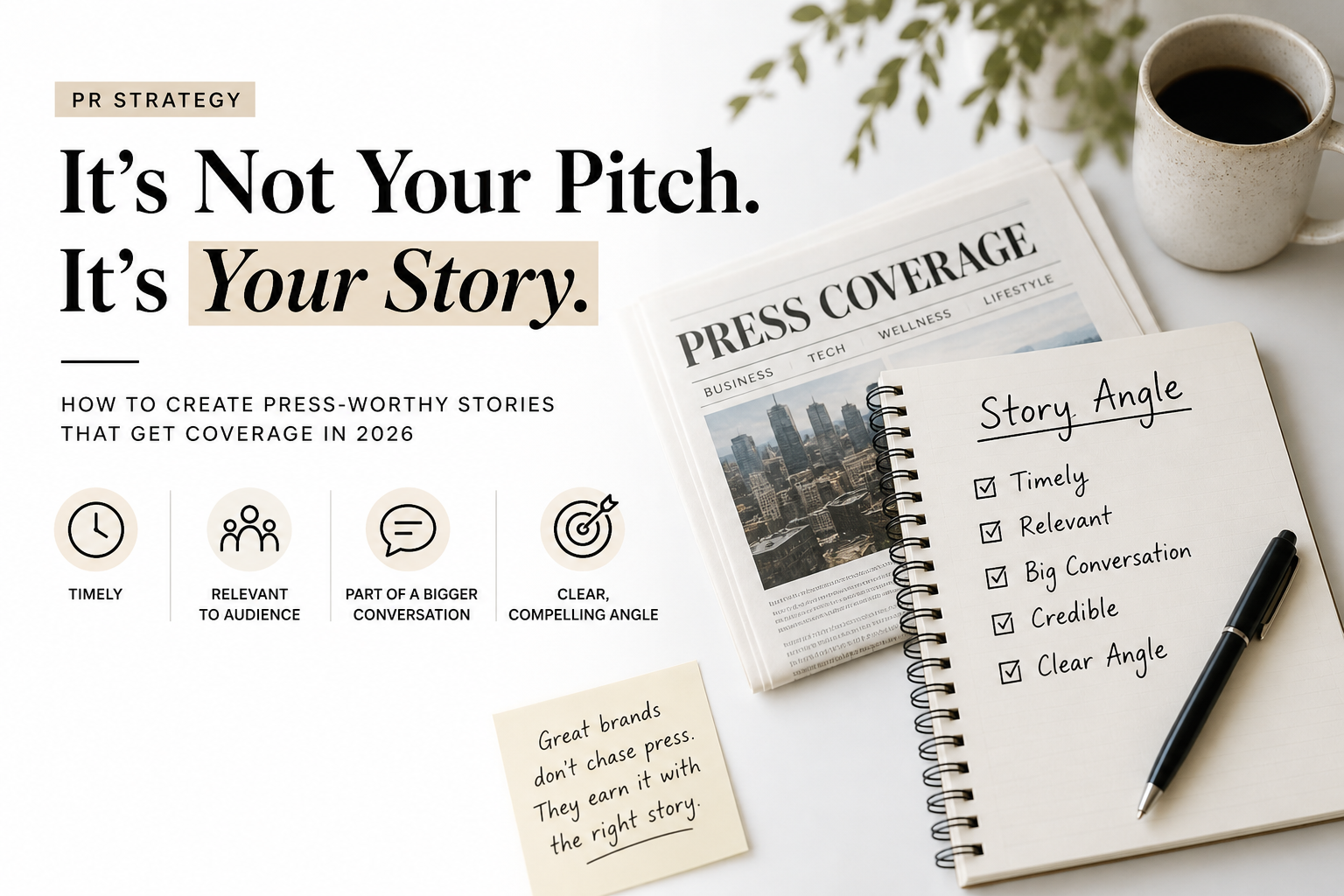
A notebook beside a newspaper, visually representing the shift from weak brand messaging to strong, press-worthy storytelling, symbolizing how shaping the right story is what leads to media coverage in 2026.
Most brands don’t have a pitching problem.
They have a story problem.
Because in 2026, getting press isn’t about how good your brand is—it’s about how relevant your story is to someone else.
Journalists are not looking for brands.
They’re looking for stories their audience will care about right now.
If your pitch isn’t landing, this is usually why.
What “Press-Worthy” Actually Means in 2026
A press-worthy story is not:
“We launched something”
“Our product is amazing”
“Our founder is inspiring”
A press-worthy story is:
Timely
Connected to a broader conversation
Framed with a clear, compelling angle
This is the difference between getting ignored… and getting coverage.
If your current approach isn’t working, read: Why Your PR Isn’t Working — And What to Do Instead (2026 Guide)
The 5 Filters Journalists Use (Whether You Realize It or Not)
Before a journalist even considers your pitch, they’re subconsciously running it through these filters:
1. Timeliness
Why now?
If your story isn’t tied to a moment, trend, or shift, it immediately feels irrelevant.
2. Audience Relevance
Does this matter to their reader—not your customer?
Editors don’t publish content for brands. They publish for audiences.
3. Cultural or Industry Context
Is this part of a larger conversation?
Strong stories tap into what’s already happening—trends, behaviors, or shifts in your space.
4. Credibility
Why are you the one telling this story?
This can come from expertise, data, results, or a unique POV.
5. Clear Angle
Can this be turned into a headline?
If it can’t, it won’t get covered.
If you’re still thinking about how to communicate this, read: How to Pitch Journalists in 2026 (Step-by-Step Guide + Email Templates That Get Responses)
The Difference Between a Weak Pitch and a Strong One
This is where most brands get it wrong.
❌ Not Press-Worthy:
“We launched a new skincare product.”
✅ Press-Worthy:
“Why dermatologists are rethinking skin barrier repair in 2026—and what most products are getting wrong”
❌ Not Press-Worthy:
“Our founder has an inspiring story.”
✅ Press-Worthy:
“Why more founders are rejecting traditional growth models in 2026—and what it means for scaling a business”
❌ Not Press-Worthy:
“We’re a wellness brand focused on sustainability.”
✅ Press-Worthy:
“How consumer expectations around sustainability are shifting in 2026 (and why most brands are behind)”
See the difference?
It’s not about what you do.
It’s about how you frame it.
If you want to understand how this translates into actual coverage, read: How to Get Press in 2026 (Without a PR Agency)
How to Turn Your Brand Into a Press-Worthy Story
You don’t need a different business.
You need a better angle.
Here are the four most effective ways to do that:
1. Tie Into a Trend
What’s already happening in your industry?
Your story should feel like a natural extension of a bigger conversation.
2. Lead With a Point of View
Strong opinions outperform generic messaging.
What do you believe that others aren’t saying?
3. Use Data or Insights
Original data, client results, or internal insights instantly increase credibility.
Even small data points can become a story if framed correctly.
4. Reframe What You Do
Instead of describing your product or service, position it within a shift.
Example:
Not “we offer PR services”
→ “why brands are rethinking how they earn media in 2026”
(You’ve already started doing this—this is where your positioning gets strong.)
The Biggest Mistake Brands Make
They confuse internal importance with external relevance.
Just because something matters to your brand doesn’t mean it matters to the media.
And that disconnect is exactly why most pitches get ignored.
If this sounds familiar, read: Why Your PR Isn’t Working — And What to Do Instead (2026 Guide)
A Quick Test: Is Your Story Actually Press-Worthy?
Before you pitch anything, ask yourself:
Would someone outside my industry care about this?
Is there a timely or trending hook?
Can this be turned into a compelling headline?
Does this add something new to the conversation?
Am I leading with value—or just information?
If you hesitate on any of these, the story likely needs stronger positioning.
Final Thought
Press doesn’t come from being a great brand.
It comes from telling the right story, at the right time, in a way that actually connects.
And most brands don’t need more outreach.
They need a sharper angle.
Want Help Finding Your Angle?
If you’re not getting press, it’s usually not a visibility issue—it’s a positioning issue.
I help brands turn what they do into stories that actually land with media.
If you’re ready for that shift, let’s talk.